Tag Archives: The Inkling

Happiness

The Prime Minister couldn’t help hearing when we Australians complained about doing it tough. She’d been trying her best, but the opinion polls just kept getting worse. “What do people want?” she asked herself. “How can I make people happy?” Then she had an idea.

“What if I appoint a Minister for Happiness? If I can make voters happy surely I will get more votes. I can see it now…”

Radio announcer: The Opposition Leader this morning announced his opposition to the appointment of a Minister for Happiness, insisting “Australian’s don’t want to be happy!”

“Why aren’t Australian’s happy?” asked the Minister for Happiness

Australia appears to have everything it needs to be a happy country.  We have a peaceful lifestyle with little physical discomfort, the freedom to make our own choices and express our opinions, the right to vote, abundant food to eat and resources to trade, relatively fair work conditions and free healthcare and public education. We have a higher than average life expectancy (1), a comfortable climate to live in, four weeks holiday a year and a high GDP.

With all our wealth and comfort, you would expect us to be a nation of happy, or at least content, individuals.  But are we really?

 “I’d like to point out that suicide is one of the leading causes of death in young people, second only to road accidents (2), and if the current rate of reported cases of depression and other anxiety disorders is anything to go by, then it looks like there are plenty of unhappy Australians. The 2007 Mental Health Council of Australia statistics show that almost half the population, (45.5%), is likely to experience a mental health disorder in their lifetime.  Around 1 million adults and 100,000 young people live with depression each year.  In the period 2006 – 2007, 20% of 16 – 85 year olds experienced some sort of mental disorder.  That’s more than 3 million Australians! (3) Mental Illness is costing the government $20 billion a year (4)” the Health Minister commented.

“Ahem…“ said the Minister for Housing. “Might I add that mental illness is not the only worrying issue here? I think it is worth noting that only around 55% of the population owns their home outright (5). The other 45% of the population is either burdened with large rent or mortgage repayments, the insecurity of temporary accommodation or they are one of the 105,000 Australians who don’t have any home at all (6)” 

“Don’t forget the rate of lifestyle-related deaths” said the Health Minister. “The 2009 Australian Medical Association report on obesity estimated that 9,500 deaths occur annually in Australia as a result of diseases and conditions such as cardiovascular disease, type 2 diabetes, and cancer that are attributable to excess weight (7), to which low self esteem and poor diet contribute.”

“Instead of appointing new Ministers, the Prime Minister should concentrate on getting the Ministers she already has to do their jobs properly” said The Opposition Leader

“Let’s assume that Australia meets the basic human needs of its population” said the Prime Minister. “Apart from simply surviving, what else do we need to live enjoyable, worthwhile, fulfilled, happy lives?”

What is Happiness?

Ed Deiner, a psychologist from the University of Illinois makes a good point on what he recognizes as happiness in an overview of his study entitled “Defining and Measuring Happiness (Subjective Well Being)” (8).

“Life satisfaction, pleasant emotions, and unpleasant emotions are separable, different components of happiness and unhappiness. Life satisfaction differs from the affective components of happiness in that it is based on a reflective judgment. In addition, there is the distinction between eudaimonic happiness and hedonic happiness, the first being characterized more by virtue and reason, and the latter being characterized by pleasure. We argue that each facet of well-being is deserving of scientific study, regardless of which one researchers might argue is true happiness.”

“I suggest we take a fresh look at happiness and reexamine our understanding of what it is exactly” said the Minister for Happiness. “Unfortunately His Holiness The Dalai Lama couldn’t be here today. I was lucky enough, however, to attend the Happiness and Its Causes Conference in Brisbane recently where His Holiness and colleague Alan Wallace talked extensively on this topic (Alan Wallace is founder and director of the Santa Barbara Institute of Conscience Studies and a leading Buddhist scholar).

“Prime Minister, how happy do you think the struggling Australian taxpayers feel when they hear that their hard work is paying for tickets to a Happiness Conference?” said the Opposition Leader

Alan Wallace recognizes a clear difference between happiness caused by external stimulus, “the type of happiness that arises because of some stimulation or something good happening to us…” and  genuine happiness which he describes as “a type of satisfaction that endures, that is cultivated… well being that arises independent upon stimulation… without external support” (9). His definition would suggest that the fleeting kind of pleasure we seek in material things, favorable circumstances and enjoyable activities is not genuine happiness.

Also according to His Holiness The Dalai Lama (in dialogue with Natasha Mitchell at the Happiness and Its Causes Conference in 2011), happiness is a calm mind, a mental state of satisfaction.  This state of mental satisfaction he considers to be the result of spirituality or “dealing with the mind.” He also stresses that spirituality cannot be bought, but something that people can “only develop through their own mental training”.  However, the cultivation of spirituality and intellect are not to be confused, as His Holiness The Dalai Lama acknowledges that intellect alone, without heart, can bring a lot of disaster (9).

Similarly Eckhart Tolle in his book “Power of Now” speaks of the joy and peace to be discovered in accepting the present moment and all that it is.  Observing without judgment, acknowledging that nothing is lacking. (10)  

The Buddhist viewpoint also gives great importance to the role of compassion in cultivating happiness.  In addition to the mental training of the intellect (increased awareness of reality, reduced ignorance), compassion is the practice of combining the awareness and acceptance of reality and the very Buddhist concept of selflessness.  Or as The Dalai Lama puts it “Compassion, take as a seed.  Then we use human intelligence, then reasoning, (and) add a kind of warm heartedness.”  Compassion is an essential part of happiness because “it allows us to understand. (an)Altruistic attitude brings (us) together” (9).  “Now, in order to build a happy world, a peaceful world that ultimately depends on compassion. So our target should be a compassionate world…” (11)

So what I’m proposing is that compassion is perhaps a value that is underestimated in our western culture because it is more about understanding and connecting with others, rather than satisfying our own personal needs.  Maybe our definition of happiness should have more to do with acceptance and understanding than with pleasure and personal satisfaction?” finished the Minister for Happiness

“The Australian people are compassionate. What the Government should be asking for is forgiveness” said the Opposition Leader

How do you cultivate a calm mind, a mental state of satisfaction, an acceptance of what “is” and compassion?

Ron Leifer MD points out in his book “The Happiness Project “ (12) that religious faith is one way that people find more mental calmness and therefore more happiness.  He says there are two paths that people tend to follow in their search of happiness through religion (12, p 12 – 13)  One goes in the direction of obedience to a God who has the ultimate authority to judge what is right or wrong (exoteric path).  The other is more about searching within and removing your own barriers to happiness (esoteric path).

The exoteric path relies on the belief of a superior external agency or ‘God’ who needs to be pleased by following prescribed rules or doctrines.  The followers of this path also tend to believe in divine justices, such as rewards for the virtuous and punishment for the sinners.  This belief, in Leifer’s opinion, seems to imply that virtuousness is a source of happiness for the exoteric path followers.  Ron Leifer believes that ‘the relationship between virtue (doing the right thing) and happiness has been largely forgotten or deeply repressed in modern society.” (12, p 12)

“I can hardly believe what I’m hearing!” said the Opposition Leader. “Is the Prime Minister telling me that I should go to church?”

The esoteric path, on the other hand, believes that knowledge and awareness, or wisdom, is the way to unlocking the secrets we hide from ourselves. “The keys to the kingdom of happiness lie in wisdom… What makes wisdom wise is that it helps us to find a greater degree of happiness and to reduce the load of sufferings we impose on ourselves and others.” (12, p 14)  Leifer describes this path as being more about living in harmony with life by facing and accepting facts.  This also includes accepting one’s own desires and fears and to “differentiate good desires and fears from those that cause us pain and suffering.” To find a graceful balance between “grasping for happiness through our desperate, compulsive, instant satisfaction of our desires,… or rejecting, denying or repressing desire and pleasure as if they are “the  doings of the devil.” (12, p 15)

The esoteric path usually involves a personal transformation or “spiritual awakening as a result of these steps” (13), which involve actual changes in behavior.  This concept is also used in many 12 step recovery programs for addicts, adapted from the Alcoholics Anonymous 12 steps.  Personal action is crucial to the success of these recovery programs.  As the addict progresses on their path to recovery they will discover that many of their “defects of character” (13) are actually the very obstacles that prevent them from finding fulfillment and happiness.  The concept of personal transformation agrees (and may well have originated from) the Buddhist view that ‘the primary cause of suffering is attachment to self – a state of ignorance which creates the ego.” (12, p24) Much of modern psychotherapy also practices these principles by examining the patient’s responses to external events and ‘working through’ the painful emotions using increased awareness, acceptance and realization (actual change in behavior) (12, p 19 – 21).

Dr Tim Sharp, Chief Happiness Officer of The Happiness Institute, recognizes that gaining a national level of happiness is a very complex business, and that realistically nothing is likely to work for everyone, and certainly won’t work all the time.  He does identify, however, some of the most basic needs that humans need to live generally happy, contented lives as safety, secure housing, access to adequate food and water, financial stability and communal support.  After the basic needs are met, democracy, stable politics, tolerance, access to good public health, education and transport, equity in the workforce and equity in wealth are also likely to increase the chances of more people achieving happiness (14). 

“I knew it! All this talk of happiness is just a front for wealth redistribution” said the Opposition Leader. “She wants us to believe that we will be happier if we give her all our money! Will the next announcement be a tax on frowns?”

Tim Sharp believes that our national happiness could be improved if we were to put more emphasis through the media and in schools on values such as tolerance, fairness, justice, perseverance, optimism and hope, love and kindness.  Tim Sharp advocates the importance of education, and the difference that positive psychology learnings could have if more widely introduced into our education system.  “Imagine if every child learned how to think optimistically, build their resilience, develop and foster positive relationships and use their strengths?  Surely that would, over time, lead to a happier and better society with more flourishing and fewer problems.”(14)

“Social engineering!” cried the Opposition Leader

Alan Wallace (11) mentions that “…there is a quality of genuine happiness [Tibetan translation], that arises by leading a truly ethical way of life.  A benevolent way of life, an altruistic, a caring, a loving way of life. And so this is a quality of wellbeing that comes not from what we’re getting from the world, but from what we’re bringing to the world.

And so when it’s something that arises because of what we bring to the world, no-one can take it away. If you’ve been kind in the morning to another person and afterwards you feel a contentment, a kind of satisfaction about that. No-one can take it away, right? Whereas for the corrupt person, whose happiness is all derived upon getting things from the world, take away all that support, take away all the support, put them in a room by themselves and now see how happy they are. “ (11)

Ed Diener from the University of Illinois also found that “The happiest people all appear to have strong social relationships.”(8)

 “So why are these simple lessons not given more priority or at least as much as is given to educating young people into high income paying careers?” asked the Minister for Happiness. “Maybe we also need to rethink what it is we really want to achieve in our lives and redefine our concept of success”.

How do you measure happiness?

“You can’t manage what you don’t measure” said the Prime Minister.

“So how is the Prime Minister going to measure happiness?” asked the Opposition Leader. “Is she going to go around counting smiles?”

There tends to be a general understanding that success has to do with wealth.  But what if we were to change the focus of our attention away from wealth and relate success to our level of happiness?  Gross Domestic Profit (GDP) is the most widely used comparative tool for measuring performance (or success) of a country’s economy.   It is relatively easy to calculate, based on tangible figures, yet has its limitations. 

Measuring happiness is a bit more complicated, but it can be done.  Simply measuring monetary transactions may be a more convenient, concrete method for measuring performance (compared to measuring Gross National Happiness which is more complicated to measure, since there are many different interpretations and aspects of happiness or well being which can be used as factors for measuring happiness (see appendices 1 – 3)) but how does the total amount of money exchanged within a country determine our enjoyment in what we spent it on? What exactly does it tell us about our well being as individuals? Is this really a fair indication of our ‘success’ as a country?

“If we didn’t have a strong economy, we wouldn’t be able to afford the great standard of living we have now, and I can assure you that Australia would be a much unhappier place if you were to take that away” said the Opposition Leader.

The concept of Gross National Happiness (GNH) has been around since the 1970’s and is gaining worldwide interest.  It was the former king of Bhutan, His Majesty Jigme Singye Wangchuck who first came up with the concept and then began developing a road map back in the 70’s for implementing a GNH index into Bhutan (15).

The GNH index was officially adopted into Bhutan in November 2008 with the introduction of full parliamentary democracy and the coronation of the 5th King of Bhutan, His Majesty Jigme Khesar Namgy Wangchuck. Bhutan has benefitted greatly and continues to enjoy a high GNH.  A big part of their success could have to do with the GNH being compatible with Bhutan’s existing culture of Buddhist spiritual values.

“And now we are all to become Buddhists!” said the Opposition Leader.

The Buddhist ideal suggests that beneficial development of human society takes place when “material and spiritual development occur side by side to complement and reinforce each other.”(16)  The four pillars of GNH are the promotion of sustainable development, preservation and promotion of cultural values, conservation of the natural environment and the establishment of good governance (16). International scholars have observed that these four pillars are generally transcultural and a nation doesn’t need to be Buddhist to value them (16).  In fact if you take a look at some of the indicators and developmental areas used in compiling the GNH index, (appendices 1 – 3) they are all indicative of the quality of life that we Australians value. 

Treasurer:  Yes, I’ve had a look into these.  But what about Ed Deiner’s study from the University of Illinois, which compared nations to each other using a scale he developed called subjective well being (SWB). His study focused on factors relating to happiness and quality of life, like all the others, but his findings were that “high income, individualism, human rights and social equality correlated strongly with each other, and with SWB“(17) Wouldn’t this be an argument in favor of the importance of GDP? 

The GDP cannot be disregarded completely.  It may be another contributing factor of GNH, however, in another study by Adrian G White of the University of Leicester in 2007, “A Global Projection of Subjective Well-being: A Challenge to Positive Psychology?” (18), the Satisfaction With Life Index (SWLI), (developed as part of the study) ranked Bhutan  8th out of 178 countries.  Australia ranked 26th in the same index.  In 2010 Bhutan had a relatively low GDP of US$598 per person (a GDP of US$1.397 billion (19) and a population of 2,337,211(20)). Compare this to Australia which in 2010 had a GDP equivalent to US$56,000 per person (GDP of US$1,236 billion (19) and a population of 21,885,016 (20)). So you can’t automatically link a high SWB with high income.  This correlation may be more coincidental or indirect.  It could be argued that Bhutan’s success in the Adrian G White survey has more to do with Bhutan’s focus on making GNH a priority despite their low GDP.  Other low GDP countries may not have done so well, in the Adrian G White survey simply because they have not adopted this concept as a priority in the same way as Bhutan has.  Not that Bhutan is particularly interested in competing with other countries. Their stated goal is “to maximize whatever they see as GNH, not compare numbers with other countries.” (16)

Can the government create ideal conditions for happiness?

Dr Tim Sharp of the Happiness Institute tends to think that a large component of being happy has to do with personal choice.  Once our most basic needs are met, it would appear that it is up to the individual to create their own happiness.  Education may play an important role in helping people to learn ways to be happier, but we can not necessarily impose happiness on everybody, or expect to be happy all the time.  Tim Sharp believes that one of the most effective and beneficial ways to promote happiness and well being is through wider education of positive psychology in schools and to teach new skills and ways to train ourselves to be happier and more resilient (14). The Happiness Institute suggests you can choose to be happier by practicing the following disciplines every day (21):

C = Clarity (of goals, direction and life purpose). Happy people set clear goals and determine clear & specific plans to ensure these goals become reality.

H = Healthy Living (activity & exercise, diet & nutrition, and sleep). Health forms a crucial part of the foundation to happiness. It’s hard to be happy if you’re literally sick & tired all the time

O = Optimism (positive but realistic thinking). There’s no doubt that happy people think about themselves, others and the world differently. Among other things, they search for more positives.

O = Others (the key relationships in your life). Research strongly indicates that happy people have both more and better quality relationships. So make sure you devote time to developing and fostering your key relationships.

S = Strengths (your core qualities and attributes). Rather than spending all their time trying to “fix” their “weaknesses”, happy people spend more time identifying and utilising their strengths.

E = Enjoy the moment (live in, and appreciate the present). The past is history, tomorrow’s a mystery, and today’s a gift – that’s why they call it “the present”. Live in the moment and enjoy life more.

Allan Wallace reminds us that “there’s not just one method (to happiness): not just meditation, not just science – complementarity.  And if we brought this into education – not bringing in Buddhism, but training young people how to really become scientists of their own experience, and ask through their own experience: what truly makes me happy? ” (9)

“The general agreement of the experts seems to be that happiness is more about appreciating and enjoying the things we already have, rather than seeking fulfillment and pleasure in external things” said the Prime Minister.

“Did you hear that?” said the Opposition Leader. “The Prime Minister says that if you aren’t happy you’ve only got yourself to blame.”

Leifer says “happiness is not to be found in the outer, social world, but in transformation of mind which generates wisdom, tranquility and compassion.” (12). So, it can be concluded that happiness is something we mostly cultivate at a personal level, but it can also be encouraged on a community level and methods for increasing happiness can be taught at a national level.

“Our next step is to develop a set of happiness indicators for Australia, and then work out how we can sustain those things that are important to us” Announced the Prime Minister.

“Yes, that’s where the challenge begins” said the Minister for Happiness

Appendices

Appendix 1 – The Centre for Bhutan Studies Eight General Contributors to Happiness (16)                        

“Through collaboration with an international group of scholars and empirical researchers the Centre for Bhutan Studies further defined these four pillars with greater specificity into eight general contributors to happiness-

  1. physical, mental and spiritual health;
  2.  time-balance;
  3.  social and community vitality;
  4.  cultural vitality;
  5. education;
  6. living standards;
  7.  good governance; and
  8. ecological vitality.”

Appendix 2 – The Seven Development Areas for Socioeconomic Measurement (16)                                

“The second- generation GNH concept, treating happiness as a socioeconomic development metric, was proposed in 2006 by Med Jones, the President of International Institute of Management. GNH value is proposed to be an index function of the total average per capita of the following measures:

  1. Economic Wellness: Indicated via direct survey and statistical measurement of economic metrics such as consumer debt, average income to consumer price index ratio and income distribution
  2. Environmental Wellness: Indicated via direct survey and statistical measurement of environmental metrics such as pollution, noise and traffic
  3. Physical Wellness: Indicated via statistical measurement of physical health metrics such as severe illnesses
  4. Mental Wellness: Indicated via direct survey and statistical measurement of mental health metrics such as usage of antidepressants and rise or decline of psychotherapy patients
  5. Workplace Wellness: Indicated via direct survey and statistical measurement of labor metrics such as jobless claims, job change, workplace complaints and lawsuits
  6. Social Wellness: Indicated via direct survey and statistical measurement of social metrics such as discrimination, safety, divorce rates, complaints of domestic conflicts and family lawsuits, public lawsuits, crime rates
  7. Political Wellness: Indicated via direct survey and statistical measurement of political metrics such as the quality of local democracy, individual freedom, and foreign conflicts.

The above seven metrics were incorporated into the first Global GNH Survey.


Appendix 3 – Overview of the Centre For Bhutan Studies Psychological Well being Survey Report, 2008 (22)

“Research studies around the world have shown that although economic growth has increased steeply over the past decades, there has been no rise in well-being. GNH stands for holistic approach towards governance as it values not only the economic capital but also the social, emotional and spiritual needs of the people. A GNH society calls for the inclusion of people’s perceptions on their well-being. The domain of psychological well-being consists of the outcomes of life circumstances and achievements. For these reasons we should measure this valued outcome so that policy makers are better informed and situations are better assessed. It is essential for policy decisions to be influenced by issues related to psychological well-being. Psychological well-being indicators attempt to understand people’s evaluations of their lives. Currently, we have four broad categories under which we attempt to study psychological well-being of the Bhutanese people. They are life satisfaction, emotional well-being, spirituality, and stress. The findings of this research paper provide interesting policy-related issues but further continuous assessment of well-being would offer policy makers a much stronger basis to making informed policy decisions. Our proposed system of psychological well-being indicators is aimed to not only supplement economic indicators but also to enhance their value by placing them within overall framework of tracking GNH.”

Special Thanks To

Dr Tim Sharp, Chief Happiness Officer, The Happiness Institute

Thanks Also To

Philip Delepervanche

Peter, Lawson Street

Peta Landman

Lyn Schlunke

David Mannah

Sid Tapia

Emile Ortega

Kaushik Sridhar

Terry O’Brien

Simon McDonald

Residents of Golden Grove Street who gave away their books

and The Gadigal People of the Eora Nation

References

  1. Australian Institute of Health and Welfare, Life Expectancy For Selected Countries By Sex, How Australia Compares, 2005-2010 [accessed 10/07/2011]. Available from: http://www.aihw.gov.au/life-expectancy-how-australia-compares/                                                     
  2. Royal Children’s Hospital Melbourne, Centre For Adolescence Health, Youth Suicide in Australia, Facts & figures [accessed 13/07/2011]. Available from: http://rch.org.au/cah/research.cfm?doc_id=10396
  3. Health Council of Australia, Mental Health Fact Sheet, 2007 [accessed 13/07/2011]. Available from: http://www.mhca.org.au/documents/AboutMentalHealth/FactsonMentalHealth.pdf
  4. Council of Australian Governments (2006), National Action Plan On Mental Health 2006 – 2011 [accessed 13/07/2011]. Available from : http://www.coag.gov.au/reports/docs/AHMC_COAG_mental_health.pdf
  5. Australian Bureau of Statistics, 4102.0 – Australian Social Trends, 2007 [accessed 14/07/2011]. Available from: http://www.abs.gov.au/AUSSTATS/abs@.nsf/0/835719233482EF4ACA25732C00208159?opendocument
  6.  Australian Bureau of Statistics, Census 2001 – 2006, Homelessness In Australia Fact Sheet [accessed 14/07/2011]. Available from: www.homelessnessaustralia.org.au
  7. Australian Medical Association Obesity Report, Nov 2009 [accessed 13/07/2011]. Available from: http://ama.com.au/node/3033
  8. Deiner E, Overview Defining and Measuring Happiness (Subjective Well Being), University of Illinois, 2009 [accessed 19/07/2011]. Available from: http://internal.psychology.illinois.edu/~ediener/discoveries.html
  9. ABC Radio National, All In The Mind, broadcast Saturday 25 June 2011, Dialogue with The Dalai Lama Part 1 [accessed 30/06/2011]. Available from : http://www.abc.net.au/rn/allinthemind/stories/2011/3238541.htm
  10. Tolle Eckhart, Power Of Now, Hachette Australia, 2004, p 52
  11. ABC Radio National, All In The Mind, broadcast Saturday 9 July 2011, Dialogue with The Dalai Lama Part 3 [accessed 12/07/2011]. Available from: http://www.abc.net.au/rn/allinthemind/stories/2011/3249471.htm
  12. Leifer Ron, The Happiness Project, Snow Lion, ISBN 1-55939-079-4, 1997, p 12 – 24
  13.  Alcoholics Anonymous Twelve Steps [accessed 13/07/2011]. Available from: http://www.aa.org.au/members/twelve-steps.php
  14. Dr Tim Sharp, The Happiness Institute, Australia, Email Interview, 4 Jul 2011
  15. Centre For Bhutan Studies, Gross National Happiness, Explanation of GNH Index [accessed 10/07/2011]. Available from:  http://www.grossnationalhappiness.com/gnhIndex/intruductionGNH.aspx
  16. Wikipedia, Gross National Happiness [accessed 8/07/2011]. Available from: http://en.wikipedia.org/wiki/Gross_national_happiness
  17. Deiner E, Factors Predicting The Subjective Well Being of Nations (Abstract), 1995, Department of Psychology, University of Illinois, USA [accessed 13/07/2011]. Available from:  www.ncbi.nlm.nih.gov/pubmed
  18. Satisfaction With Life Index, White A G,  University of Leicester, UK 2006 [accessed 13/07/2011]. Available from: http://en.wikipedia.org/wiki/Satisfaction_with_Life_Index
  19. Wikipedia List Of Countries By GDP [accessed 20/07/2011]. Available from: http://en.wikipedia.org/wiki/List_of_countries_by_GDP
  20. Population of Bhutan/Australia, True Knowledge [accessed 20/07/2011]. Available from: www.trueknowledge.com/q/population
  21. The Happiness Institute, CHOOSE [accessed 10/07/2011]. Available from: http://www.thehappinessinstitute.com/freeproducts/docs/CHOOSE%20handout%20summary.pdf
  22. Centre For Bhutan Studies, Gross National Happiness, Overview Psychological Well being Survey Report, 2008, [accessed 10/07/2011]. Available from: http://www.grossnationalhappiness.com/surveyReports/psychological/psycho_abs.aspx?d=pw&t=Psychological%20Wellbeing

Want to buy us a chocolate?


July 2011 Challenge

We challenged Simon to make something functional from rubbish.

CHI-CYCLING: THE CONCEPT

Everyone knows recycling. Welcome to Chi-cycling. Chi  (pronounced ‘chee‘ and sometimes spelt Qi) is the traditional Chinese idea of life force or the energy that flows through everything. Chi-cycling is about combining what you already have in new ways to create something useful by adding the vital impulse of human imagination. Recycling can turn used plastic packaging into new plastic packaging.Chi-cycling can turn used plastic packaging into anything. It can turn a cardboard tea box into a wallet. In a few seconds it can turn a humble paperclip into a funky Scandinavian-inspired incense holder.

THE CHALLENGE

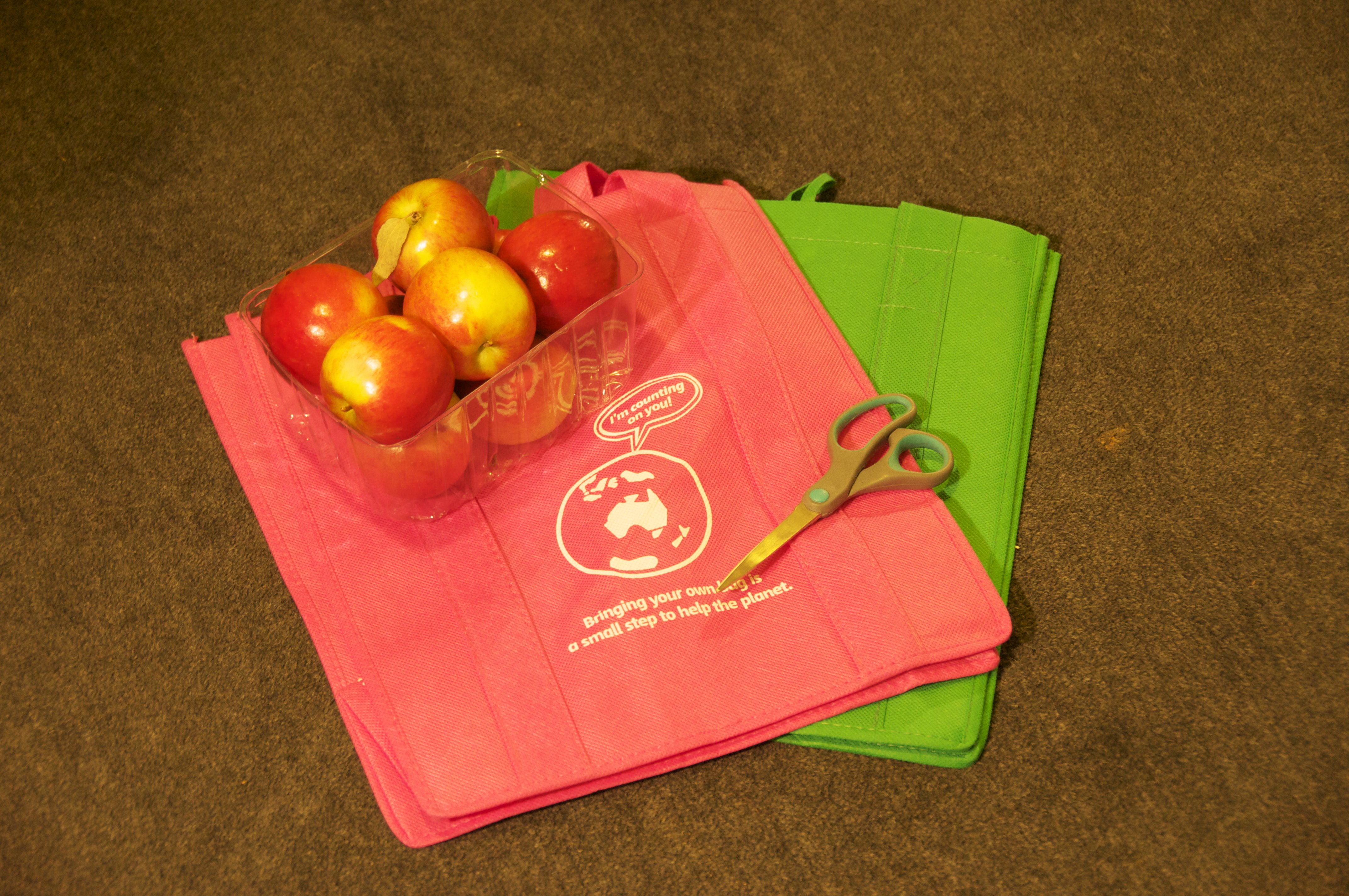
I was challenged to build something out of recycled materials that I would otherwise put in the bin. I decided to build something I’d been thinking about for a while – a vertical garden – out of plastic packaging and supermarket ‘green’ bags. I love apples and it seems bizarre to me that some apples are sold in large rectangular plastic boxes. One of the beautiful things about fruit is that it needs no packaging. I decided that these boxes would be my basic building material and over the course of two weeks ate lots of apples.

Materials

BACKGROUND

A vertical garden is a garden that is geared for the metropolitan landscape where space is at a premium. Many plants are climbers and can happily grow in the vertical plane. Walls can become living walls. This idea is starting to gain traction in architecture and expect to see more and more of them in coming years. Hanging gardens are one aspect of this vertical movement and involve sets of garden beds one underneath the other allowing excess water to flow with gravity from the higher to the lower ones.

OUTCOME

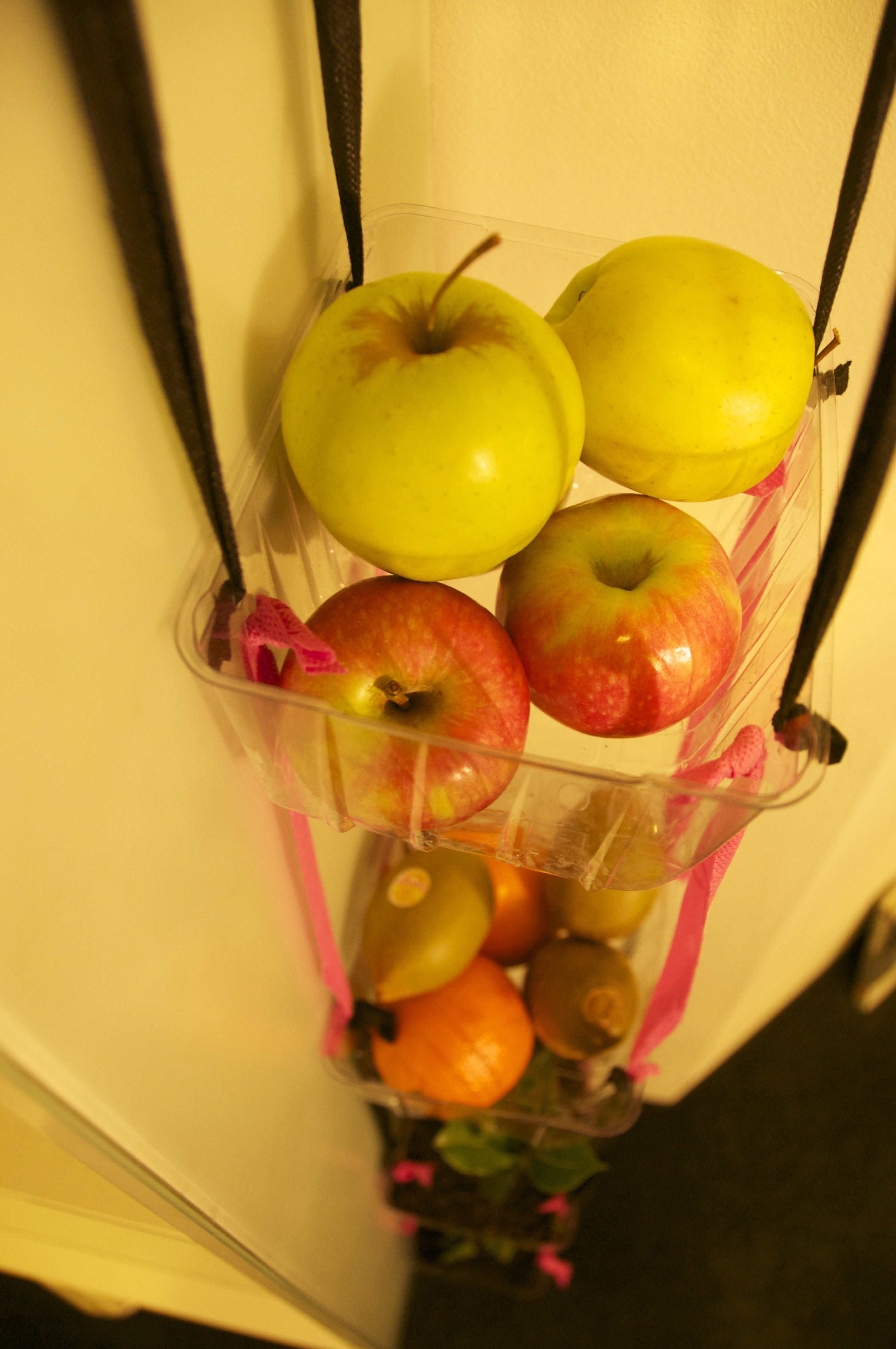
The challenge went well. You can see all the building materials in the first photo and the final result in the others. Building this vertical garden did involve tying more knots than your average Inca quipu but the plastic green bags retain the knots well with little slipping. I did some strength testing on it before adding the soil and was surprised by just how strong the whole thing was. During this phase I decided to make it a hybrid structure that was part vertical garden and part fruit basket to add some colour to the room while the greenery is growing. Lower to the ground where there is more light I planted sage leaf, a curry plant and a flower. If you love making things out of things too it would be cool to hear from you.

Top of vertical garden

Fruit holder

Plants

OTHER POSITIVE EFFECTS

Chi-cyling is definitely an uplifting experience and its the same part of you that sees the wallet in the tea box that sees the opportunity in the crisis and the silver lining in the cloud: the part that senses the possibility for transformation. So why just think outside the box when you can grab the box and turn it into something awesome!

Simon

Want to buy us a chocolate?


The Inklings: Chapter 5

D’arby was used to being called a dreamer. It was usually said in a condescending tone, but it never really annoyed him. What did annoy D’arby was when someone told him that he was dreaming if he thought one person could change things. D’arby was disgusted with people who gave up without even trying and even more disgusted with those who thought that discouraging comments were wise advice. He considered these people to be free-riders. He knew that they must have benefited at one time or another because of the actions of someone who did try to do good things despite being only one person and despite knowing that almost everybody thought that what they were attempting couldn’t be done. D’arby thought that people who said that things couldn’t be done were just making excuses for their own reluctance to do anything. Carrying on as usual and letting other people do all the important things and make all the important decisions was the lazy way out.

Despite his belief that he should be trying to do something good, D’arby often found that he wasn’t doing much at all. To decide what he was going to do about his PhD D’arby had bought a train ticket home to his parent’s house. While he was there he did a lot of walking in the bush around the house. That gave him time to think and he realized that at uni he’d been made ashamed of his view that he could make a difference. People accused him of being arrogant. Perhaps this being ashamed was what had gone wrong. D’arby decided he wasn’t going to let himself be ashamed of it anymore.

This renewed belief, that everybody could do something and that it was their responsibility to do so, was what gave D’arby the strength to think about his PhD in a new light.

First, he went over the past few years and remembered everything he had thought and felt. He remembered how when his supervisor had first complained that D’arby’s work wasn’t progressing well he’d thought himself lazy and then as more time passed D’arby had thought himself stupid. D’arby now realized that his laziness and inability to achieve what his supervisor wanted weren’t the problems but symptoms of the problem.

The real problem was that D’arby didn’t think his research was worth doing. He’d chosen the project because it sounded interesting (his supervisor would have been equally good at a sales career). D’arby wanted to be able to understand this complicated chemical reaction, but he didn’t think it would make much difference whether the answers were known or not – the industry had existed for years by trial and error and would keep on going without knowing D’arby’s answers (and D’arby wasn’t even sure that he wanted the industry to keep going at all – why hadn’t he considered that before!).

It was not until now, nearly three years later, that D’arby realized what he had gotten himself into. D’arby looked up at the cold blue sky and asked why he hadn’t been able to work out what was wrong until now when it was so clear. Now that D’arby could finally see the problem, he knew what he had to do about it.

“Less worrying and more action” said D’arby to himself. He’d decided to just get on and finish his thesis. He’d do whatever he had to do to get out of that awful place. If he stopped thinking about how awful it was and just concentrated, surely that would help him! But to help him get through the awful stuff he needed something else. This something else was D’arby’s secret project. It was only a few months after he started his PhD that he became interested in other research. When he should have been looking up papers relating to his project he couldn’t help looking at publications on other topics. His secret project was the research that he really wanted to do. D’arby’s deal with himself was that for every week he was productive at uni he could spend the weekend on his secret project. If he made his supervisor smile he could work four days in the next week on his PhD project and three on his secret project.

However, D’arby found that the best way to make his supervisor smile was not to try to do what his supervisor wanted. Like so many problems that are difficult to solve, D’arby’s PhD problem had a solution that was the opposite of what you would think it would be. Instead of trying to make his supervisor happy, what D’arby had to do was to ignore his supervisor completely and do what he thought should be done. This was what got him results, and the results made his supervisor happy. Every week or so, when D’arby bothered to go to see his supervisor (there were no more regular meetings since D’arby had stopped going to them) he would show him new and exciting results and they both knew that they would soon have enough for a very good thesis.

D’arby’s only problem was that his scholarship had just run out and so he’d have to get a job soon, but he was too busy already! D’arby was very excited by both his projects, but became quite stressed when he looked at his bank balance. He was frustrated that as soon as he climbed over one barrier, a new one appeared. D’arby’s supervisor assumed that D’arby had saved money in anticipation of this, or that D’arby’s family could help him out.

Maybe D’arby was too good at hiding his distress and behaving “normally” because nobody noticed that something was wrong with D’arby – not even his friends, even though D’arby mentioned to them that he’d soon run out of money and didn’t know what to do. They found it easy to assume that he’d be ok since he still managed to smile and laugh. The truth was probably that D’arby’s friends were too absorbed in their own problems to be able to donate any thought to his. And what problems!

“Cate and Suzy hate each other but both of them are my friends (although I prefer Cate). Should I invite both of them to my party, or just Cate?”

“My computer monitor has broken and I want a flat one but my supervisor doesn’t agree and says I should use his old boxy one, but that will leave me no space on my desk.”

“I’m going to Nepal for six weeks. Should I go to India after Nepal, or should I go to Thailand and lie on the beach for two weeks?”

“I can’t afford the house I want. I want three bedrooms on a quiet street in a nice suburb, within walking distance to a train station and restaurants, but I don’t want a terrace house and there must be off-street parking for the car because of the insurance and a garden because what’s the point of a house if not to have a garden?”

And so on. D’arby noticed that the more a person thought they knew, the more they had to analyse the minor things – as if each decision they made was a competition – a chance to display their superior intelligence. But spending time analysing minor things took up so much time that there was none left for action. D’arby wondered if the most important thing he’d learnt at uni was that if you take long enough trying to make a decision you will find you no longer have to make a decision because your options will have all evaporated. Not that D’arby minded discussing things with his friends at uni. He had learnt a lot from them, but he just hadn’t done much.

D’arby hated applying for jobs, but it taught him another important lesson. It seemed that the longer you spent at uni, the less employable you became outside universities. To be fair, he’d been a bit fussy in the jobs he’d applied for and hadn’t spent much time looking, but after sending out applications for two months, he hadn’t been offered a single interview. He was lacking experience and there were no part time jobs where his qualifications were essential. He knew his approach to job seeking was wrong but he didn’t know what to do about it. As usual, D’arby would find that when what he was doing felt wrong, it was because it was the wrong thing to be doing.

Afternoon was turning into evening on a Friday in spring, and D’arby was walking up the street to get a Thai takeaway. The sunlight was amazing. It was so golden that it made everything it hit look beautiful. The street normally looked shabby and rundown, but in that light it was the perfect street – where perfect, smiley people lived their happy lives and never worried about anything.

John wasn’t happy though. He was standing in the lane way, waiting. He peeped around the corner saw D’arby coming along the street, not paying attention to anything but his own thoughts. D’arby was confused when he found himself being dragged by the neck into the lane way. He thought it must be some sort of joke until he realized that there was a knife against his throat. John was expertly going through D’arby’s pockets with his left hand, while keeping half an eye on D’arby and half an eye on the knife. John soon discovered that D’arby hadn’t brought his wallet (not that there was any money in it) and had just enough money in his pocket to pay for a Thai takeaway. John started swearing in frustration but continued to search D’arby’s other pockets. “Bingo” said John when he found a little snap-lock bag with some pills in it. He wasn’t sure what they were but they looked homemade and so were probably illegal. John let go of D’arby, dexterously opened the little bag and popped a pill into his mouth.

John felt the pill start fizzing as it got to his stomach. It reminded him of the time he’d swallowed the kind of aspirin tablets that are supposed to be dissolved in water before you take them. Then John realized that D’arby hadn’t run away – he was still there, watching John.

”Why is he watching me?” thought John. Then he began to panic. What had he just eaten? Was this man a murderer who had just poisoned him? John could imagine that there were plenty of people who thought it would be funny to kill a drug addict. The police would probably be grateful for a drop in theft. John fell to his knees and stuck his finger down his throat, but he was in too much of a panic to be able to vomit.

D’arby could see that John was panicking and began to panic too.

“Calm down” said D’arby. “It wasn’t poison” said D’arby, but his tone was more hopeful than convincing.

The fizzing had stopped. John sat down on the footpath and began to feel better. He was actually beginning to feel pretty good. He wasn’t experiencing anything euphoric, but he felt calmer than he had for a long time.

For years John had been racing through life, living from craving to craving. Now, for some strange reason, he felt like he didn’t have to do that anymore. No more rushing. He had plenty of time to change things.

John could have spent hours sitting there, reflecting on who he was and where he’d gone wrong. D’arby was getting bored and hungry though. He cautiously tweaked the $10 note from John’s hand (John paid no attention) and tried to decide what to do next. D’arby wanted to go and get his Thai takeaway, but he was scared that John would be gone by the time he got back so he encouraged John to stand up and come with him. John was so caught up in his own thoughts that, although he was aware of D’arby, he didn’t care where he was taking him.

John remembered how he and his father had seen an alcoholic sitting drunk in the gutter when John was about 6 years old. John had asked his father what the man was doing and his father had said “I’m sure that man was born without problems, so he made them for himself”. John hadn’t taken that warning from his father. As a teenager John had never appreciated how lucky he was to have a bright mind and everything he needed. Instead John had decided to make his own problems. He didn’t talk to his parents anymore – they didn’t want to talk to him.

D’arby and John sat in the park. D’arby had one takeaway meal and two forks. John was drawn out of his deep thoughts by the smell of food. Like D’arby, John was very hungry.

Now that it looked like John wasn’t going to die D’arby felt very excited. He would have got up and jumped up and down a few times if he didn’t think that John would take the opportunity to eat all the food. Perhaps it was too soon to tell, but it looked like his pills had cured a drug addict. He was amazed and how calm and normal John seemed now. He’d been so scary before.

“How do you feel?” asked D’arby

“What’s your name?” asked John. He had never been very comfortable talking about how he was feeling, and asked the question in an annoyed tone.

“D’arby” said D’arby. “So how do you feel?”

“Well, I’m John, thanks for asking” replied John, but D’arby didn’t care that John thought he was being rude. D’arby never paid much attention to names and he didn’t think that remembering a person’s name was very important. It was just something people did to trick you into thinking that they cared about you.

“I thought you were trying to kill me” said John

“Well, I could say the same about you” said D’arby,

“What did you give me then?” asked John. He still wasn’t sure he could trust D’arby, or that he was going to be alright.

“I didn’t give you anything. You stole my pills” complained D’arby.

“You know what I mean!” said John “What was it?”

“Something I came up with in the lab” said D’arby. “I’ve been trying to make something to cure addiction.”

“So you’re a doctor then?” asked John, feeling relieved

“No, an engineer” replied D’arby

John scratched his head, with a pained expression on his face. Everything had seemed to clear a few minutes ago, but now nothing was making sense.

“Have you tested the pills? What’s going to happen to me?” asked John.

“Not really, but I’ve eaten heaps of them and nothing’s happened to me” said D’arby.

Then John started laughing at himself for caring about what he’d taken.  After everything else, what difference would it make? He was happy that he felt like caring again.

Want to buy us a chocolate?


Advice from The Spark

I try so hard to be nice, but no matter what I do, I always seem to get it wrong.  At work I am constantly being criticised and whenever I try to help by telling people what needs to be done I get snapped at and treated like a nuisance.  Even if I try to show an interest by asking questions about how my colleagues projects are going, I am ridiculed for my ignorance and made to feel like a halfwit.  Nobody appreciates me.  I feel like I would be doing everyone a favour if I just disappeared.  What should I do?

The way you describe your colleagues sounds very much like the behaviour of people under pressure.  They no doubt have lots of things on their minds and little patience for distractions.  You probably feel as though you are helping by reminding when important things need to be done, but to people with lots to remember and never enough time to do everything, any extra reminder of something they seem to have neglected may feel like an accusation or just an extra burden for them to carry.  They will most likely reject or resent your concern.  That’s normal.  It’s most likely that your colleagues are not even aware of your feelings because they are so caught up in their important business, but I very much doubt that anyone intends to criticise or put you down.  A workplace can be a brutal environment for sensitive emotions, so please be aware of your surroundings and don’t take other people’s harsh responses personally.
You suggest disappearing… Well maybe you could try this in a subtle way by avoiding the battle ground of communication with your colleagues and not entering into discussions until they invite you to.  Wherever possible leave your messages, inquiries and reminders in writing, in a business-like, respectful manner, and then put them out of your mind.  Once you have dealt with them in this way, you will have done all you need to.
Forget about trying to be nice.  You can never please everybody, so stop wasting your time and energy trying so hard to be nice.  Your attention will be far more wisely invested in completing your tasks at hand to the best of your ability, and respecting that your colleagues will attend to theirs.  Don’t resent their attitude.  It is not your fault, nor can you fix it.  Just accept the pressure they are under and do what you can to be serene, attentive to your actions and enjoy yourself.

The Spark

Want to buy us a chocolate?

Would you like some advice from The Spark?

← Back

Thank you for your response. ✨


Advice from the Spark

I am in love with a woman who is in a relationship with another man. Sometimes I think she has feelings for me but I can’t tell for sure. Should I tell her my feelings?

I find it strangely ironic that you are asking my advice about matters of the heart.  I’m a spark!  I don’t have a physical form, therefore I am completely unaffected by emotion.   Still, it’s probably very sensible of you to ask a spark.  You are no doubt under the influence of this mindless state of infatuation that you humans so clumsily label as love, which is actually no more than an emotional loop that has grown in your neurons.  You have developed a tight little neural net which when triggered by some memory or thought or interaction with the victim of your obsession (Dear me.  If I had eyes I would be rolling them right now) it sends a signal to a gland in your brain to inject endorphins into your blood stream which gives you a high.  You have now grown attached to this pattern and cannot envisage how you would cope without a constant supply of this stimulation which you associate with this woman.

I apologise for my lack of sensitivity.  I consider this adoration that human beings have for one another as a condition that borders on insanity, and I have very little patience for it.  Probably because it closes down the rational, peripherally conscious parts of the brain which make in unreceptive to spark influence.  So whenever my host brain goes into this mode I am forced to depart.

Getting back to your problem; very sensible for you to seek a rational, sparkly objective viewpoint, although I very much doubt that what I tell you is what you want to hear.

What do you expect to gain by sharing your feelings with a woman who cannot respond to them?  Do you truly believe that her feelings for you may be strong enough for her to leave her partner and devote herself to you?  I am guessing that this is what you desire… But do you honestly believe you have the power to cause her to do that?  The cold hearted answer is no.  You cannot make this woman act or feel any way that you want her to.  You cannot control her feelings or actions, and if you believe that you may be able to influence her in any way, then I’m sorry, but you are insane.

If you don’t expect her to leave her partner, but think she may be interested in a secret little affair, just to flirt with the possibility of one day running off together and living happily ever after, then I would suggest you ask yourself seriously if you are willing to bare the pain and dissatisfaction, the guilt of deceit and possibly even the loss of your friendship with her (not to mention your dignity), because some, if not all of these things are certain to come to you if you proceed down this path.

If you are simply fantasizing about having sex with this woman and feel you cannot control your animal desires, then be honest with yourself and don’t call it love.  Love deserves far more respect than that.  Unless she initiates a purely sexual no-emotion-attached type exploration with you, then I would suggest you keep your fantasies to yourself and enjoy them as fantasies.  I am witness to this scenario and can assure you that most fantasies of this kind are far more enjoyable as fantasies than the realities of them actually occurring.

So my advice to you is the easiest to give and sometimes the most difficult to follow.  Simply do nothing.  You cannot cause love to blossom all by yourself, nor can you avoid it.  If this woman loves you and your love was meant to be then one day you will be thrown together and there will be no doubts.  If you are in doubt right now, do nothing.  If you do nothing, what you have right now will not be lost.  Treasure your feelings for her now as they are without expecting anymore from her in return.  Don’t be greedy.  Give her space and respect and have patience and faith that all will fall into place without your clumsy intervention.

The Spark

Want to buy us a chocolate?

Would you like some advice from The Spark?

← Back

Thank you for your response. ✨


The Inklings: Chapter 4

Syafika thought she was madly in love. She was definitely behaving crazily. She’d made a cake for the only person who made her want to go to work – Anthony. Then she told him she’d made the cake because he was leaving, but what she really wanted him to understand was that she loved him and didn’t want him to leave.

After lunch the people at work gathered to eat the cake. Anthony gave a short speech, taking the opportunity to thank everybody and give compliments. He thanked Syafika for the cake and everybody agreed that it was one of the best chocolate cakes they’d tasted. Someone even asked Syafika for the recipe.

Still, when Syafika walked home, she carried the empty cake container unenthusiastically. The day had been such an anticlimax. In her dreams Anthony was much more impressed by the cake and had begged her to come to Adelaide with him. In reality Syafika had listened to Anthony announce that his girlfriend was pregnant. Everybody clapped, but all Syafika could hear was “girlfriend”. What girlfriend? Syafika had been so convinced that the love she felt for Anthony meant that he had to be for her. She’d never heard anything about his girlfriend and she’d never considered that he might not be single. She felt even more stupid and left out when it seemed that everyone else knew about Anthony’s girlfriend.

As Syafika walked back through the park she realized that it was raining again, and that she had left her umbrella at work, but she didn’t care that she was getting rained on. She didn’t know how she would care about anything anymore. Then, just to make things worse, she realized that she was such a small part of the world that it didn’t matter what she felt anyway.

It didn’t help that when Syafika got home her cousin Ousman was there, with her aunt Binta. Syafika’s Mum Rose was still at the beauty salon. She went there weekly and her appointments always went twice as long as they were supposed to. Syafika’s father Festus would always say that Rose was having an affair with her beautician. Syafika loved her father but not when he said things like that, because she wasn’t really sure whether he was serious or not.

Binta was cooking dinner when Syafika came into the kitchen. Binta always did things like that. Rose was so disorganized and Binta was so much the opposite that Binta couldn’t bear to be in their house unless she was allowed to do some cooking, cleaning or organizing. Rose didn’t care. She had told Binta to come for dinner and then hadn’t made any attempt to have anything ready on time. Syafika preferred Binta’s cooking to her mother’s and would have been pleased to see her in the kitchen if it didn’t mean that Ousman would also be there.

Nobody believed Syafika when she said she hated Ousman. He was a 10 year old boy and everyone thought he was cute, with his curly hair, big eyes and round cheeks. He was also incredibly precocious, which was the reason Syafika hated him. Ousman thought he was smarter than her. How dare a 10 year old think that! Ousman was also very good at arguing and his confidence made it look like he knew much more about things than he really did. He was determined to argue with Syafika whenever he saw her.

“Hey Syaf!” said Ousman when he saw her. “Did you read the article in the paper today about how corrupt your government department is? Have you been taking bribes at work?”

Syafika put the dirty cake plate on the kitchen bench and walked to her room without answering Ousman, but he didn’t give up that easily and followed her down the hallway.

Syafika slammed her bedroom door and moved her bed in front of it to prevent Ousman from coming in. “What a little shit!” she muttered as she dialled her friend Fanta’s number.

“Fantaaaaaaaaaaaaa! I’m dying!” said Syafika when Fanta answered. Of course Fanta said she’d come over straight away.

Fanta had just got back from her holiday that morning, but Syafika had been so obsessed with Anthony for the past month that she hadn’t even realized that Fanta was away. Fanta has sent Syafika a postcard, but it was still in a mail bag in another country and would arrive in a few days time. In their last conversation Fanta had told Syafika to keep away from Anthony and so Syafika had been avoiding Fanta. She only remembered Fanta now because she needed her.

Rose had just got back from the beauty salon when Fanta arrived and Binta was about to serve dinner. Syafika was still sulking in her room, and Ousman was sitting on the floor outside her door, reading the paper. Rose asked Fanta to stay for dinner and stormed up the corridor to get Syafika. Rose only got really angry with Syafika when she was sulking. She picked Ousman up by the elbow and propelled him down the corridor in the direction of the dining room. “Syafika!” she yelled through the door. “Stop being so childish and come and have dinner. You can sulk in your room as much as you like afterwards. Fanta is here.”

Rose heard Syafika’s bed being pushed away from the door and knew Syafika was coming so she went to start putting plates on the table.

Syafika was confused when Fanta greeted her with a present and even more confused when she opened it and saw it was a painting of some trees. Her aunt Binta was far more interested in the painting than Syafika. Syafika didn’t even listen as Fanta explained to Binta where she’d got the painting. Fanta’s voice was a faint “blah blah blah” in the background of Syafika’s thoughts. She was thinking about Anthony, of course. It was only when Fanta mentioned love that Syafika tuned back into the conversation. “He said you needed respect and trust as well as love to marry someone” said Fanta as she finished her story.

Festus thought it was his turn to say something. “Where’s Amanda tonight then?” he demanded. Amanda was Syafika’s 16 year old sister. She was a difficult teenager. When Amanda was fourteen her parents had discovered that she’d been sneaking out at night. Festus was so angry that he installed a bolt on the outside of Amanda’s bedroom door and locked her into her room for the night. The next morning he found her lying outside on the concrete driveway with a broken leg – she’d tried to escape in the middle of the night by jumping out of her third floor bedroom window. This really scared Festus, especially as he only found Amanda when he was about to reverse the car over her. It scared him so much that from then on he decided to let Amanda sort herself and now she was allowed to go wherever she wanted whenever she wanted.

Rose had also given up on Amanda. When beauty treatments and shopping hadn’t cured her Rose had started to treat Amanda like an invalid. Amanda didn’t seem to mind this, perhaps because it meant that her mother did everything she asked. Amanda stopped eating with the family and got Rose to bring her food to her bedroom. She also stopped going to school and spent most of the day sleeping.

As her older sister, maybe Syafika would have helped Amanda more, but Syafika just thought that Amanda was being selfish and needed to grow up. She started to ignore Amanda completely, which was pretty easy because Amanda rarely came out of her room during the hours when Syafika was awake.

After Festus’ comment the room was quiet for a while. Then Ousman, who had been reading the paper while eating, began to laugh at an article he’d found and started reading it aloud for everyone else’s benefit. Syafika thought she’d eaten enough to be able to leave the table and took Fanta with her.

“What happened?” asked Fanta, when they were safely in Syafika’s room, with the bed in front of the door.

“You are always right Fanta, but this time I’m glad I didn’t listen to you” said Syafika, and she started crying. Fanta sat down on the bed next to Syafika, and although she knew what must have happened, she asked “What happened?”

“You remember how I told you about Anthony?” asked Syafika. Of course Fanta remembered. Syafika hadn’t had anything else on her mind for months. Fanta nodded and Syafika continued.

“I didn’t stop thinking about him, like you said I should. I stopped talking to you instead. You must be angry. I haven’t called you for weeks – although you didn’t call me either!”

Fanta didn’t say anything, so Syafika continued.

“When I called you today, it was because I was feeling really empty” said Syafika, and tears started to flow. “Anthony is leaving, but that’s not the really bad thing, the really had thing is that he has a girlfriend and she is pregnant!”

“Syafika, did anything happen between you and Anthony?” asked Fanta.

“No” said Syafika.

“Well, that’s good then.” said Fanta. “And it is good that he is leaving – it will make it easier for you to get over him.”

“So you are happy that he didn’t even notice I existed? I knew you would be like this” said Syafika. She was getting angry, but it wasn’t really with Fanta. Fanta always got straight to the heart of things, and Syafika was angry with herself because she could see how stupid she’d been. For months she’d been telling Fanta every detail she knew about Anthony. Fanta had heard about every word Anthony had ever said to Syafika (except for the ten or so in the past month). Fanta knew what Anthony wore, when his birthday was and what he liked to eat for lunch. Syafika talked about Anthony like he was her husband.

“Maybe I should start stalking Anthony and his girlfriend. I could try to scare her away from him. Maybe she is the one who wants to leave, not him. If I get rid of her then maybe he will stay and I will still be able to see him at work.” said Syafika.

Fanta gave Syafika her most disapproving look, until she realized that Syafika was trying to hide a smirk. At least Syafika wasn’t taking this all too seriously. That was what Fanta liked best about Syafika. Syafika may have loved drama, but she could also laugh at herself when she went too far.

“At least now I know what it is like to love someone.” Said Syafika

Fanta didn’t say anything. She didn’t think she was experienced enough in love to be able to tell Syafika that she thought what Syafika felt for Anthony was more like obsession than love.

Want to buy us a chocolate?


The Inklings: Chapter 3

D’arby left his supervisor’s office feeling more deflated than he thought was possible. He’d felt so well prepared before the meeting. He thought he’d been getting somewhere with his work. Now he felt like a complete loser, someone stuck in a hole that he was making deeper every time he tried to climb out. D’arby couldn’t believe he would ever finish his PhD. Why did he keep trying? There were many good reasons to keep trying – because of what people would say if he gave up, because of what his mother would say, because of what his father would think but not say, because it would be his first big failure, because he didn’t want to have to explain in job interviews what he’d wasted the last couple of years doing. But the real reason was more complicated. It was a mixture of things. D’arby felt he had never been good at finishing things. He had guilty memories of promising projects he’d started but never finished. D’arby didn’t realize it yet, but he was finally learning real perseverance. He also didn’t quite realize that he actually found pleasure in having found a problem that had (so far) out-witted him. He also probably enjoyed the challenge of having a supervisor who he didn’t get along with. It would be a while before D’arby could articulate these reasons though. At that moment he was too busy despairing that there seemed no way out. The older D’arby got, the more he found that life was like that. The things he would most like to change were the hardest – if not impossible – to change.

Before the meeting with his supervisor D’arby was feeling the happiest he’d been for a long time. At last he thought he’d worked out how to get some answers. He thought his work was almost finished. He thought he’d done something good. Then his supervisor told D’arby what he thought about it all. He told D’arby that he’d been wasting time trying to do things that everyone else knew would never work. What D’arby had written was rubbish. He’d proved nothing. D’arby had been wasting time, and he didn’t have much left. Didn’t he know he’d never complete his PhD before his scholarship ran out? What was he doing with his time anyway? D’arby’s supervisor told him to report to him every day and tell him what he wanted to do before he did it, because that was the only way D’arby would ever finish. D’arby had to have some meaningful results to show by that time next week. Then his supervisor finished the meeting with a smile and D’arby tried to give one back.

After the wave of disappointment came the anger, but D’arby didn’t know if he was angry with himself or his supervisor or just the world in general. He realized he needed to ask himself some important questions but was scared of what his answers would be. Was his work crap? Was what he had done wrong? Was it bad supervision or D’arby’s stupidity that had got him into this situation? How could someone with as much potential as D’arby had have got everything so wrong? It was more likely that D’arby was wrong than that his supervisor was wrong though. Or were they both a bit wrong? Or were they both right? Did D’arby really understand his supervisor? Maybe it was just that his supervisor didn’t understand him. D’arby went to sit in the park. After a few minutes of watching the undergraduate students have lunch it occurred to D’arby that he didn’t have to go back into the building. He could just walk away and never return. D’arby was not in the mood for making decisions though. He stared into space and didn’t think anything.

Meanwhile, a man who D’arby hadn’t met yet was running down a nearby street. John was being chased by two police officers on foot and two police cars were trying to cut him off as he ran down laneways, across busy roads and jumped people’s fences. He didn’t even know why they were chasing him, not because he’d never done anything wrong but because he’d done so many things that police didn’t like that he didn’t know which one it was that had made everybody so angry. If he could find somewhere to hide, or make it to a crowded place John would be able to escape capture today. Then he’d sneak off to his sister Emily’s place for a couple of weeks, until things cooled down. His sister lived a quiet, respectable life in a leafy suburb and she had a spare room waiting for him whenever he needed it. She would know he was in trouble when he turned up because he only ever went there when he was in trouble, but she wasn’t allowed to mind because she was his older sister and was supposed to look after him. John never involved his sister when he got arrested. This was not because he wanted to keep her place as a reliable hideout, but because he didn’t want to upset Emily by letting her know what he got up to. She could probably guess, but it was better if she was only able to imagine these things. Seeing them would make everything seem as serious as it really was.

At last John made it to the uni, where he knew many places to hide. John was not very far in front of the police on foot when he made it to a toilet block. One of the cars wasn’t far away either – the siren was very loud. John chose to hide in the female toilets because he was being chased by men. Fortunately the toilets were empty. John went into a cubicle and hoped for the best. There weren’t many other places that John could have gone though and in a couple of minutes he heard the officers announce themselves before coming into the toilet block. John considered trying to push past them but then he noticed the hook on the back of the toilet door. He grabbed it and held himself up so that none of his body was visible above or below the door. Then he gently swung the door open so the officers would be able to see that nobody was sitting on the toilet. Although John was skinny it was an enormous effort for him to be able to hold himself up like that and as soon as the police decided he wasn’t there and walked out John fell to the floor. He was covered with sweat and felt too shaky to walk so he closed the cubicle door and sat there for a while.

When D’arby stood up and walked back to his desk he hoped that somewhere inside himself he really knew what he was doing. He passed John on the way. John had left the toilet block and was heading west. John was jealous when he saw D’arby, who, to John, didn’t seem to have a problem in the world. If D’arby had known what John was thinking maybe he would have tried to explain that being someone whose problems seem insignificant is a problem in itself.

Want to buy us a chocolate?


Advice from the Spark

I have so many things I need to do but I find that getting things done is such a struggle! What can I do?

Sounds to me like you are caught in a hamster wheel.  The harder you try, the faster it spins and you still get no where.  Do you feel as though each day is a trial to get through?  That every obstacle along the way presents new problems and set backs?  That from the moment you wake in the morning until you fall asleep at night you are racing against time?  Do you wish life could be easier?

What if I told you it could be?  Would you be willing to give it a go?  Because it can be.  Life can be full of excitement, love and comedy if you let it.  You can still keep up with your obligations and projects without sliding and falling behind.  In fact you may find that your methods are smoother, more efficient and more creative when you allow life to be and work with it, rather than against it.

There’s no use in fearing or dreading the day ahead.  That’s not going to change anything apart from putting you in a bad mood and making it harder for yourself to cope with the day’s challenges.  Instead, when you wake in the morning put yourself trustingly in the hands of the present moment and make a deal with the day to accept what comes your way and cooperate by playing your part as it unfolds for you.  Each day is a gift.  Don’t reject it ungratefully by wishing it were different, but appreciate the opportunities you are given.  To the inexperienced many opportunities may be confused as problems.  Don’t be fooled.

Where are your problems now anyway?  Are they pounding on the door, trying to all come in at once to “get” you?  If they are, welcome them in. Give them your full attention and cooperate with them by doing what is required of you.  There’s no need to judge or resist them.  They exist, so calmly and mindfully deal with them one by one.  Notice and enjoy the feeling of harmony when working with life, rather than against it.

Or you may notice that your problems are not really out there after all.  It may be that the only place they exist right now is in your mind.  Perhaps the only thing that requires your immediate attention right now is to breathe and to be in this moment as you put this step of your plan into action.  That is all you ever really need to do. As you do so, respect your actions and give them the attention they deserve.  This will help you to go about your tasks more effectively with less stumbling and tripping.

If you are out of step with life’s rhythm you will feel like you are fighting a current, forcing your way through, exhausting yourself without gaining pleasure or satisfaction from your activities.  If you let life run it’s course and take the moments necessary to find your place in the rhythm and your comfortable cruising speed, life will be easier and more enjoyable.  Your actions will feel natural and effortless.  You will find that your problems often sort themselves out without your clumsy intervention, and solutions will present themselves when you are more receptive to your surroundings.  You will feel energised and alive when you find your slipstream.  You will find excitement in a challenge and pride in a job well done.  You will laugh more, attract appreciation from others and create opportunities to do all the things you never used to have time for.

Stop trying so hard.  Tension and resistance drain your energy and blind you.  Remember to breathe, accept what is, and whatever you do, make it fun!

The Spark

Want to buy us a chocolate?

Would you like some advice from The Spark?

← Back

Thank you for your response. ✨


The Inklings: Chapter 2

A long way away from Syafika was another skinny man. His name was Mamadou and today was his 40th birthday. He didn’t have a cake and it definitely wasn’t going to rain in his village. It hadn’t rained properly for months and everything was dry and dusty – more than it had ever been before. Mamadou’s house was near the top of a hill, amongst forest. The trees and plants were already looking wilted, and it was still hours before the hottest part of the day. The weather had been making Mamadou depressed. Every day that it didn’t rain he felt worse. It was another sign that his life was still going downhill.

Nobody respected Mamadou. All the young people in the village thought he was crazy and all the old people were disappointed that such a lovely young man had thrown his life away. Anyone who really knew what had happened to Mamadou felt sorry for him, but also thought he had been foolish and were glad that he’d fallen so badly after trying to make too much of himself – he should have been happy to keep the life he’d grown up with. Everyone in the village agreed that it was good that Mamadou’s mother had died before his downfall, because it would have broken her heart and killed her anyway – and death due to the pain of disappointment and embarrassment had to be worse than death from fever.

At another time, years ago, Mamadou had felt like he was King of the World, but things would never be like that again. Even if something good did happen to him, Mamadou would never let himself feel as happy again because he knew what it felt like to lose it all.

Mamadou sat on an old wooden chair in the sunshine that was coming in through his window. He was drinking tea and trying to come to terms with being 40 and having nothing to show for it, except his paintings, but not many people cared about those and none of the people who did care lived in his village. He looked at the stack of his paintings against the wall near his bed. He looked at his paints and brushes and the sketches he’d done the day before of droopy leaves in the sun. Then he looked back at his paintings and his mood began to improve. He’d sold a painting not long ago – to a tourist who’d come to the village to sticky beak. She’d come a long way and had only a small suitcase, but had bought a painting anyway. She was only young, but she’d been a good listener and when Mamadou had told her about his downfall she’d paid attention and been sympathetic. He could see that she didn’t think he was worthless like everyone else did. Mamadou looked out the window at the blue sky. There were some clouds on the horizon and they were moving closer, but they weren’t rain clouds. Although Mamadou couldn’t imagine that it would ever rain again things did look a bit brighter than they had before. The trees looked a bit fresher. The tea tasted more like tea and less like rusty water. He had to remind himself that he’d had all he wanted and then lost it, just to check if he was really feeling hopeful again or had just forgotten about the awful things. The memories came back and cut Mamadou’s stomach, but he still felt optimistic – although he didn’t know why he should.

Want to buy us a chocolate?


Advice from the Spark

I am a single, overweight 40-something. I feel like I’m wasting my life. What can I do?

What do you feel is lacking in your life right now?  Is there anything missing? Maybe you do already have everything you need to be happy, but just need to discover where your happiness and joy has been hiding.

Is there anything in your life right now that you have the power to change, which may help unblock your connection with life and fulfillment? Maybe everything is fine the way it is and you are already as happy and content as you possibly can be…  But the fact that you are asking me this question indicates that you have some doubt within yourself.  Maybe it’s not obvious and pressing, but more of a persistent itch that feels like it can never really be scratched satisfactorily.

You mention your weight… This would be the most obvious problem a human would focus on.  As a spark, I can assure you that your physical shell is not really you, but merely a reflection of how you view and treat yourself.  Maybe it could be suggested that your excess weight is the manifestation of your unsatisfiable hunger, rather than the cause of your discontent.  It is completely normal for humans to feel perpetually hungry for fulfillment.  This is usually the explanation behind so much of their irrational behaviour.  Your discontent may even be aggravated by the form in which you attend to your hunger (this is often the case).  Hunger, naturally, you would associate with food, so it’s perfectly logical that whenever you feel the aches and pains of your discontent, you reach for the most automatic, tried and trusted remedy, which in your case may be food.  This action no doubt calms your discontent temporarily, but the long term, chronic itching persists.

Rather than feeling uncomfortable in your body because you judge it as being overweight, why not recognise your weight as the result of mistreatment.  Is food really the only way for you to satisfy your hunger?  Why not vary your emotional diet with more nutritious, longer lasting activities which fertilize the growth of true happiness or aid in the re-ignition and maintenance of your inner flame.

This is probably sounding like a whole lot of cosmic rubbish.  What you really want is reassurance and simple answers.  So let me suggest to you some clues which will lead the way to rediscovering your true self and ultimately your true happiness:

* Think of the times in your life when you have felt most alive.  What was that feeling like?  Remember it intensely.  What allowed you to feel that way then?  What is stopping you from feeling that way again now?

* Think of all the fun you have had in your life.  Do you still do any of those things now?  If not, why not?  What’s stopping you?

* When was the last time you experienced a soulful connection with another Human Being? I don’t just mean during sexual intercourse. Think about times when you have opened your heart to a friend or sibling or parent, maybe even to a stranger, and shared with them your true feelings?  What gave you the courage to do it then?  What’s stopping you from doing it again now?

You don’t need to stop doing any of the things you are physically doing, or give up deriving pleasure from food.  Food is not the problem, it’s just not the only answer.

Be aware of all the other opportunities for soul fulfilment that life gives you each day.  When you see an opportunity to try something new or do something differently, take a risk.  See what happens.  Be brave.  Live each day as if it were your last.

The Spark

Want to buy us a chocolate?

Would you like some advice from The Spark?

← Back

Thank you for your response. ✨