Use Your Enthusiasm Wisely

I was going to ask you how to lose 10 kilos and keep it off. I would also like to ask you how I could manage to have long term relationships (platonic and business not just romantic). I would also like to know how I could sustain interest in hobbies or work. But I realise that I have one basic problem and that’s what I’d like you to help me fix. I don’t know how to have a balanced life. It is all or nothing. I go through periods of eating what I like and being a slob and then I become obsessed with diets and calories and run marathons to lose the weight, but I am never able to just maintain the weight loss. I love my friends, colleagues and partners so much at first and then suddenly I’m “over” them. I become obsessed with new jobs or other activities for a while (doing nothing else) and then stop doing them completely. I wish I could manage to enjoy people, interests, food and exercise without going overboard. Please help me.

You have a lot of enthusiasm for “new” things, which is great.  There is nothing wrong with enthusiasm.  It is a wonderful stimulant, motivator and activator.  The secret with enthusiasm is how to make it last, or how not to use it all up at once, and then lose interest completely in the trigger that caused the enthusiasm in the first place.  It’s important for you to understand that none of these new interests, goals, people or pleasures are the cause of your “going overboard”.  They are only ever just the current focus, or the outlet for your enthusiastic bursts. The only way to regain any kind of control over the pressure of your tap is first by being aware, and then by choosing to moderate your responses.

You need to watch your reactions.  Be aware of the feelings these external stimulants arouse in you and watch how you react to those feelings. As you notice the first little bursts of energy, feel yourself getting carried away and visualize your internal enthusiasm-o-meter rising fast.  Feel yourself getting caught up in the momentum as your enthusiasm and need for immediate action takes hold. At the same time as your enthusiasm-o-meter races towards the “red zone”, visualize your energy levels dropping fast, (like the mercury in a thermometer), as you head towards the “burn-out zone”.

This process may accumulate over several days or weeks and may not be obvious at first.  The increases in enthusiasm may be slow or fluctuating, but just notice the changes you are feeling in mood and any changes in your behavior.   At first just watch it. Don’t try to change it, just let it run its course and be the witness to your own crash and burn.

Next time, watch it again as it begins, takes hold and heads towards the “crash zone”.  Notice the point at which you feel you are no longer in control and that you are running on impulsive, automatic need, as opposed to steady, calm, clear-headed decision making. Do regular spot-checks. Ask yourself “Am I getting carried away?” “Are my expectations of this solution/person/my own ability  unrealistic?” “Will I be able to sustain this momentum?” If you notice you are no longer asking yourself this regularly, there is a good chance you have stopped being aware and are no longer in control.  Notice this too. Identify the point where you stop making rational decisions and begin to act on impulse.

Watch very closely how your behavior changes past this point. What are the common sign posts? Is this a familiar path? Where does it lead?  Over time you will see the pattern repeating as it begins and you will get to know “the warning signs”.

Remember to monitor your enthusiasm-o-meter and energy thermometer when you notice these first warning signs and then try to moderate your enthusiasm output and energy consumption to maintain yourself within the “safe zone” or at a speed you can maintain and feel comfortable in.  The ideal efficient zone for optimum performance is a smooth cruising speed.  Decide where that is for you, and make this your goal. You may not be able to control the conditions of the road or the impact of the obstacles, but you can control your speed and your corrective responses.

Don’t be too hard on yourself whenever you notice that you are “doing it again”. So many people do it.  Humans are real suckers for novelty, and not so good at long-term commitment.  It’s normal, in varying degrees, but in your case it may be a bit more extreme.

Use your enthusiasm wisely.  It is a useful tool, but save it for when you really need it.

The Spark

Want to buy us a chocolate?

Would you like some advice from The Spark?

← Back

Thank you for your response. ✨


The Inklings: Chapter 8

As much as D’arby respected maths, he had to admit that sometimes one plus one did not equal two. He and John were one example.

D’arby always had ideas, but rarely bothered to do much with them. John was always wanting to do something but never knowing what to do. John was amazed with the things D’arby said. D’arby was amazed with the things John did. The things D’arby said triggered John to act and the things that John did made D’arby think and say more. They were like a runaway reaction.

John insisted that now that D’arby had developed his special pills and done some testing (on him and John) it was time for him to use them for something good. D’arby had been thinking of finding a job where he could continue this research. He hoped to start real trials and eventually (maybe in 15 years) his new cure for addiction would be manufactured legally by some big drug company and sold in chemists. However, this plan was full of obstacles. First D’arby would have to finish his PhD and then the examiners would have to pass him. Then he would have to find a suitable research position, then he’d have to find funding for his project and only then would the real work start! And what if after all that the pills didn’t really work or made people sick? Why was it that such a huge discovery could make D’arby’s life so much harder?

John laughed at D’arby’s idea for the pills and came up with a much simpler plan, a plan that would get results faster, but was probably not a good idea in the long term. John’s father owned a pizza restaurant, and John had recently been walking past it in the hope of bumping into his Dad. While doing this he had noticed that there was an ad in the window for a manager. John hoped that now he wasn’t using drugs anymore his father might be convinced to let him run the pizza restaurant. Then John would just add the pills to the pizza dough (they were fizzy so they might help make the dough rise). Then anyone who bought pizza would have all their addictions cured. John and D’arby could watch what happened and wouldn’t have to tell anyone anything. They could also make their living this way, as long as the pizza was nice enough for people to want to buy it. John reckoned that the hardest part of his plan would be convincing his father to let him have the restaurant. Then the second hardest part would be running the restaurant. Making the special ingredient would be easy because D’arby knew how. D’arby could have a special lab at the back of the restaurant. The pills were mostly made of really common things and needed only a couple of chemicals that you couldn’t easily buy. D’arby had already mentioned that he had enough of the hard-to-get chemicals left over from his legitimate experiments to make millions of the pills. John didn’t think it would be too hard for D’arby to sneak these chemicals home – they’d probably only be thrown out after D’arby left uni anyway.

At first, D’arby was horrified by John’s idea. It was a week since they’d first met. John was still off the drugs and not even tempted to go back. D’arby expected that John wouldn’t need a second dose. The pills were meant to work on the brain in a permanent way and D’arby couldn’t see how the change could be reversed, but he wanted to wait and see a bit longer until he was completely satisfied of that. D’arby wished he’d known John better before he’d taken the pills so he could see if there had been any other changes. He was particularly interested to know if John would have made such ridiculous suggestions before, because D’arby was worried that since he had also taken the pills he might also start thinking that it was a good idea to lace pizza with the special ingredient. D’arby worried about this because, despite his initial horror, after considering John’s plan for a couple of hours, D’arby had begun to find certain aspects of the plan appealing. Managing a restaurant would solve their money problems. John had moved in with D’arby but the rent would soon be due and D’arby didn’t have any money left. The other thing that appealed to D’arby was being able to set up his own lab. It was hard to make his pills at uni. People were so nosy. He had to be very careful not to leave anything lying around that might lead the other people working in the lab to ask questions about what he was doing. It was getting particularly difficult now that his official experiments were finished. D’arby was supposed to be spending all his time working at his computer now, not down in the lab.

So, D’arby ended up agreeing with John that they should at least try to get John’s father to let them run the pizza restaurant. Then when they had some money they could decide what to do next. Putting his special pills in the pizzas was still horrific to D’arby. That was a very unethical thing to do and not very scientific either. How would they even know if anyone was cured? They wouldn’t be able to give the customers questionnaires to fill out before and after.

So John called his father, but not before he got his sister Emily to mention to his parents that John wasn’t a drug addict anymore. Perhaps it would have been better if Emily had really believed this first. She had only seen John once since he’d taken the special pills, and although John did seem different, it was not enough to convince Emily. She was worried that John was just playing a trick on her and her parents in order to get some money out of them, although she couldn’t really see how running a pizza restaurant would get John money in a way that was quick enough to satisfy a drug craving.

“Hello Dad!” said John

“What do you want?” asked his father.

“I want to be the manager of your pizza place” said John

“No way!” said John’s father

“But I need a job!” whined John. “Nobody else will give me one and I need something to do all day, otherwise I’ll end up in trouble again.”

“That’s your problem!” said John’s father. “Don’t try to make me feel guilty. I’ve tried to help you many times and each time you just used me. I’ve given up trying to help you now.”

John knew his father hadn’t given up yet though, because his father would have hung up by now if it was true.

“Just give me one month! Let me show you? Please?” said John.

There was a long pause. Just when John was starting to think his father had walked away from the phone he said “Ok then. One month. If profits are up after a month you can stay.”

“Woo hoo!” said John after he hung up the phone. Then he did a victory lap of the flat and wondered whether D’arby would mind that they started work tomorrow. It was meant to be John’s job, but he needed D’arby’s help to get him organized. Once they had established a routine, John would do all the work (apart from making the pills) and D’arby could go back to uni. John had already been experimenting with his special pizza dough. Even with the fizz of the pills, it still needed yeast to rise, but John thought the pills made the dough taste a bit better, or at least they didn’t make the dough taste funny.

Want to buy us a chocolate?


You Are Your Best Quality

I find it very difficult to relax and enjoy myself in social situations.  My friends are always inviting me to parties, although I suspect this is only because they feel sorry for me,  and every Friday afternoon I dread the inevitable invitation to “drinks” after work.  I don’t even like drinking alcohol!

Every time I make an excuse for not attending a party or get-together I go home feeling ashamed and left-out.  If I feel I can’t get out of an invitation and I do end up attending a party, I almost always spend the whole night having painfully put-on conversations with people who try to get away from me as soon as it is polite to do so, or I stand in the wrong place, getting in people’s way, feeling awkward.  I can’t even pluck up the courage to thank the host and say my goodbyes when I’ve had enough, so I either sneak off when no one’s looking, or have to stick it out until lots of other people start leaving, so that I don’t draw attention to myself. 

At work, or with one or two close friends I feel very comfortable and confident being organised and busy.  I enjoy interacting in these situations and believe that I am a good worker and a helpful friend. But in social situations, I feel like I have nothing to offer.  I watch other confident girls who can dance and make people laugh, and always seem to know how to say the right things. Compared to them I feel old, and frumpy and useless.

I’m 28 and don’t have a boyfriend, or even anyone who seems to be interested in me.  I fear becoming an old maid who stays at home and never has any fun.  I truly do want to find a sould mate and fall in love, but how will I ever meet anybody who will love me like this? 

Do you really believe that anybody else in these social situations is scrutinizing or criticizing you as harshly as you are judging yourself?  I would say that they are probably far too busy trying to impress each other with their stories and jokes, and trying to keep up appearances to notice anybody else’s discomfort or awkwardness. Don’t be fooled by confidence.  Most of it is just well-rehearsed bravado that people use to cover up their own insecurities.  Have a look at all the people who need to drink or consume drugs in order to enjoy themselves in social situations. Or all the comfortable couples you see at parties.  Or the ones who play music or dance or eat…  These are all coping mechanisms that people use to avoid feeling left out, inadequate or exposed when they are in a situation without any obvious task to perform except to enjoy one another’s company.  This in itself, for a lot of people, can be extremely difficult, tiresome or frightening.  They way you feel is perfectly normal.  Most people would feel exactly the same way if it weren’t for these ‘props’.

The fact that you have the courage to attend a party at all without drinking, without putting on an act or without a partner to hang off, is a very admirable thing in itself.  Your honesty is much more than a lot of people can offer to these situations. Why do you need to offer anything more than your honest presence anyway?  Imagine how much you would appreciate meeting and talking to someone just like you at one of these intimidating parties.  How refreshing it would be to find someone who is real and sincere and not pretending to be anything more than that!  The person who will love you will recognise this and will notice you because of it.

I don’t suggest that you make yourself attend all of the painful parties or get-togethers that you are invited to.  Only go to the ones you genuinely do think you would enjoy, and leave whenever you want to. You are not under any obligation to stay if you are not enjoying yourself.  You don’t need an excuse to leave.  Be gracious and say goodbye confidently.  Be aware of what you are projecting.  People who shrink or apologise are often seen as victims or get-in-the-ways.  You have no need to behave in this way, and if you do, it’s only because you automatically choose to do so.

Remember that when you go to a party or “drinks” with colleagues, you are doing so because it’s an opportunity to relax, enjoy yourself, and enjoy other people’s company. You don’t need to provide anything more than your presence and you don’t need to achieve anything at all.  Even if you don’t enjoy yourself, just observe it and accept it.  Move on.  Treat every occasion as an entertaining experiment that you participate in, rather than a test that you will either pass or fail.  You don’t need to hide or be ashamed of yourself.  You are your best quality!

The Spark

Want to buy us a chocolate?

Would you like some advice from The Spark?

← Back

Thank you for your response. ✨


The Inklings: Chapter 7

Syafika and Fanta were both 23 and had never had a boyfriend, not even a kiss. It wasn’t intentional for either of them, but Syafika took it much worse than Fanta did. Fanta didn’t seem to be very concerned but Syafika was very ashamed. She was so ashamed that whenever someone asked she told them that she had a boyfriend called Vincent. She had a well practiced description of Vincent’s appearance, personality, where he worked and good excuses for why he never turned up at parties when Syafika was invited to bring a partner. Syafika hadn’t ever told Fanta this though, because she knew how angry Fanta would be with her for having told such stupid lies.

When Anthony left, Syafika was miserable. She was especially miserable at work. Her job seemed so dull without there being the chance of meeting Anthony at the photocopier or of getting a smile from him in the corridor. She tried to hide her misery at work but was only moderately successful – her two friends Helen and Julie still noticed it. So Syafika had to make up an excuse for her misery. Over a coffee she told Helen and Julie that she and Vincent had broken up. They were already familiar with Vincent, and although they had never met him, they felt like they’d known him for years. So, when Syafika told them how she and Vincent had split up they were genuinely sad. Then, as the months passed and Syafika still didn’t seem to be back to her usual chirpy self, Helen and Julie began to be concerned. They decided that they needed to start taking Syafika out so she would fall into the path of other young men and eventually forget about Vincent.

Syafika wasn’t at all willing to go out dancing or drinking. She didn’t want to draw attention to her figure by dancing in front of anyone and she also hated the atmosphere of pubs and bars. They made her feel like she was the only one there who didn’t know what to say or do. In general she hated any place or activity where strangers would be scrutinizing her looks, movements or the things she said. What Syafika would agree to was to go out for dinner. Syafika was always much calmer when food was the central focus. So Helen and Julie sneakily decided that they would go to have dinner in a pub.

Helen, Julie and Syafika left work together and walked to the pub that Helen said had the best bistro in Sydney. As the three friends walked in the door Julie looked at her watch and said “It’s really too early for dinner. Why don’t we have a little drink in the bar before going to the bistro?”

“Yeah, that’s a good idea. Let’s sit over there where we can see everyone who comes in” said Helen, pointing to three comfortable looking chairs in a corner.

Syafika was alarmed by this modification to the plan, but didn’t want to look awkward and so she just said “Ok”. Then Syafika remembered that there was less potential for social blunders if you were the first person to buy everyone drinks and quickly asked the others “What would you like to drink?”

Fortunately Helen and Julie both asked for the same kind of wine so Syafika didn’t have to worry too much about getting the order wrong. Thinking ahead, Syafika took some money from her wallet, put her wallet back in her bag and then asked Helen to mind her bag so that she would more easily be able to carry three drinks.

As Syafika walked back to where she’d left Helen and Julie she was congratulating herself on being able to carry two wine glasses, a glass of orange juice and her change at the same time until she realized that Helen and Julie weren’t sitting there anymore. Syafika put the drinks down and sat down, trying to remain calm. Surely they must just have gone to the bathroom and would soon be back. Syafika looked at her watch and then checked to see if Helen and Julie were coming back. Then she realized she had forgotten the time and checked her watch again. She took a sip of juice and decided to look around and try to enjoy watching what other people were doing, but watching other people just made her notice when they looked at her. What must they think of her sitting alone with three drinks? Next Syafika decided to look out the window and pretend to be deep in thought. She sipped her orange juice. She wished that Anthony would walk in. Thinking about Anthony made the time pass faster. When Syafika finished her juice she looked at her watch and realized that she’d been waiting for half an hour. “What should I do next?” she wondered.

Syafika decided that she wanted to go home. Hopefully her parents hadn’t gone out because her house keys were in her bag (and her bag was hopefully still with Helen). “I’ll find a pay phone and call Mum on my walk home” decided Syafika. She didn’t think it likely that Helen and Julie were still in the pub and she was happy to have an excuse to be able to go home, but to make her excuse a really good one Syafika thought she better first have a look around the pub to make sure that Helen and Julie weren’t waiting somewhere for her.

Syafika picked up the two glasses of wine and explored the pub. The next floor was very busy. Syafika couldn’t be sure that Helen and Julie weren’t there but she didn’t want to push her way through the crowds to make sure so she walked up to the roof garden. The roof was not as busy, but that was only because it had started to rain. On her way down the stairs Syafika was thinking about where she should leave her glasses of wine when someone tapped her on the shoulder.

Syafika turned around, feeling very relieved because she thought one of her friends had found her, but instead found herself smiling at a handsome man.

“Have you lost someone, or are you lost?“ asked the man.

“I’m looking for my friends” said Syafika and blushed. She didn’t want to have to explain that her friends had taken off and left her. She just wanted to go home.

“Don’t worry! Let’s find somewhere to sit down and wait for them to find you” said the man.

Want to buy us a chocolate?


Stop Tormenting Yourself

I’m  going insane over a girl who only wants to be friends with me.  We spend a lot of time together and she shares her insecurities with me. I feel that I know her better than the men she chases who don’t seem to care much about her and usually end up hurting her.  I think she knows that I secretly love her, but I don’t think she knows how much it hurts me to have to hear about all her heartache over other men.  Why can’t she appreciate how much love and care and affection I can give her and how happy we could be together?  What can I do to make her love me?

Why do you need to make her love you?  Is it about you wanting to possess her?  To protect her?  Do you desire to get back the affection and love you feel for her? Or do you just want to have sex with her and become another of the men she chases and then discards when they disappoint her?  What is wrong with being her loyal friend whom she trusts and respects and depends on?  Can’t you see how much she already does love you?  How much she values your company?  How open and honest and close your friendship is? Be grateful for that.  You are a steady part of her life which she values and does appreciate. Surely that is worth more to her than what she feels for these other men who can never give her what you do?

Having said that, I can understand how painful it must be for you to have to witness the emotional turmoil she creates for herself with other, less sympathetic men, and how she then shares this with you. I see this as being harmful to both of you, and as much as you feel the need to help her through her pain or protect her from getting hurt, you can only really take care of yourself and your own feelings.  How much of her emotional pain is your friendship based on? Do you think you may be playing an enabling role in her unhealthy relationships with men by continuing to pick her up and make her feel better again?  You are giving her problems attention and reacting in a reassuring manner.  This may be part of the recognition she craves from these other unhealthy relationships, but you are giving it to her for the wrong reasons.  What if you were to stop being the shoulder she cries on and started being a proactive friend who allows her to feel her own pain and grow from it? Remind her that she is more than her problems. Encourage her to make the most of her skills and talents. That is what a true, respectful friend would do.  It may seem tough and insensitive at first, but she will appreciate and respect you for it in the long run.  If she stops seeking you out for comfort and your friendship dwindles as a result, then acknowledge that your friendship was maybe not as solid as you thought it was.  Maybe it is just based on her problems and your addiction to her insecurity.

You will never cause her to love you, no matter how much love and care and attention you give her.  If she ever does fall in love with you it will be completely of her own doing and it will be because she desires and respects you for the person you are.  Not for how much love you can give her. Stop tormenting yourself and give your own feelings more respect.

The Spark

Want to buy us a chocolate?

Would you like some advice from The Spark?

← Back

Thank you for your response. ✨


The Inklings: Chapter 6

A lot had been going on, but Mamadou hadn’t paid much attention. He’d been working on a new series of paintings of clouds – while he watched and waited for it to rain he’d noticed how many different types of clouds there really were and he’d decided he’d paint clouds until it rained. Then when it eventually did start raining Mamadou realized how silly it had been to plan to stop painting clouds just at the time they became most common, and so he had continued his cloud series well into the wet season.

Mamadou had heard the news but it didn’t sound new. The President had been killed by his body guard. Then the military had taken over. People had taken to the streets to protest but things had become violent. Now the leaders of the two most powerful ethnic groups were each blaming the other for what was going on.

Other people in the village were agitated by the news though. As usually happened when there was instability, the price of rice had risen and foreigners were evacuating. Mamadou expected that things would settle soon though.

Mamadou was working on a painting of drizzle, with clouds that were almost indistinguishable from the rain. He was trying to capture the moment just before a burst of sun appeared, but he was finding it a challenge. The sun often appeared briefly between periods of drizzle at this time of year and so Mamadou had been given lots of opportunities to watch this, but the moment he wanted to capture really was just a moment. Before he could work out what was going on, it was gone.

Mamadou didn’t often wish for modern luxuries but he was tempted by the thought of being able to video the moment he was trying to capture and watch it back in slow motion. Then he had second thoughts and realized that capturing the moment on video would take all of the magic out of painting it. Mamadou then became sidetracked for a little while, wondering whether any first thoughts were any good or whether second and further thoughts were the only worthwhile ones. He began to doubt that any flashes of brilliance were first thoughts, deciding that many thoughts on the topic must have come before the great one. Then the sun came out properly and Mamadou predicted that there would be no more “moments” that day. As he started washing his brushes he thought he could hear something – people were yelling. Maybe someone was arguing.

Mamadou’s house was an outlier – further up the hill than the other houses in the village. When Mamadou wanted to know what was going on in the village he liked to climb the tree closest to his house and have a look before deciding whether or not he wanted to walk down and get involved.

Climbing the tree after all the rain made Mamadou’s clothes wet and when he got up to his favourite branch he found a couple of parrots sitting there that were reluctant to move. Mamadou didn’t blame them for choosing that spot – it was comfortable and had a nice view. That didn’t stop him from shooing them away though. Mamadou took his favourite spot and then craned his neck, trying to see what was going on in the village below.

Want to buy us a chocolate?


The Emotional Blur

I’ve noticed that lately that I tend to give family and friends advice when they are worried or upset about something. Most often my advice seems to ease people’s worries or give hope, so I feel as though it is appreciated.  I get a sense of satisfaction from this, but it has occurred to me that if I were to find myself in a similar situation, I would probably not take my own advice.  I feel like a hypocrite and wonder if I should stop telling people what to do and not get involved in their problems.  What do you think?

It sounds like the people close to you trust you enough with their problems to share them with you.  It also sounds like they appreciate the advice you offer them, and perhaps come to you because they value your opinion.  If, on the other hand, you were imposing your uninvited opinions and judgements on people in the disguise of friendly advice, then I would say to you that maybe, yes, you would be better off keeping your nose out of other people’s business and keeping your opinions to yourself.  But I don’t get the feeling that this is the case with you.  I would assume that the advice you offer is sensible and compassionate, and if this is the case, then your concern for other people’s welfare is commendable.

I can understand though, how useless it may feel to you if you don’t believe in your own advice enough to put it into practice for yourself.  This disability is common for lots of people, and it’s a well-known fact that it’s usually easier to give advice than to take it.  The reason that it is so easy for you to give practical, inspired advice to others is that you have less of an emotional blur in the way to prevent you from seeing simple truths that are less obvious to those affected by their circumstances.

May I suggest to you an exercise which could be useful to you when making difficult decisions:

Notice that there is a gap between perceiving/understanding a situation/problem and then you taking action to correct it.

At that point, stop yourself if you can, and observe your impulsive need to fix it, based on your emotional response to the situation.

Imagine that you are watching another person, maybe another family member (not you), in the same situation that you are in and ask yourself what advice you would give to them at that moment.

Remind yourself that you have a choice of how to react and that you don’t need to automatically choose the response that feels most familiar or satisfying.

You may choose to trust the most familiar emotional response and go against the advice you imagined for yourself. If this is the case, it’s fine.  Do what feels right, but observe what you are doing, and remind yourself that you are acting on emotional responses, not logical conclusions based on simple truths.

With practice, the process of separating yourself from the emotional attachment to decision making will become more and more familiar. Eventually you may even find that taking the rational, sensible advice that you give to others becomes the more natural choice for yourself.

Ultimately there is no right or wrong choice in any situation, just more or less chance of favourable outcomes or unpleasant consequences, plus the infinite variety of possibilities in between. In most cases the particular action itself is less important than the intention that goes into it. Be mindful of what motivates you and remember that you always have a choice.

Want to buy us a chocolate?

Would you like some advice from The Spark?

← Back

Thank you for your response. ✨


Your number one responsibility is to yourself…

I feel like my life is slipping away from me without letting me achieve any of the things I really want to do. Every year that passes I feel older, but don’t feel that I have progressed in any way. I am so busy all the time, but don’t have much to show for it.  Is it unrealistic for me to have dreams and ambition? Maybe this is all I am capable of.  Is this really all my life will ever be?

How satisfied are you with what you have achieved in your life? You may not have conquered the great heights you dream of, but you may have established close family ties, lasting quality relationships and inspired the lives of others through your generosity, compassion and wisdom.  If you have achieved any or all of these things, there is no need for you to feel unaccomplished.  Many people never succeed in achieving any of these things.  Having said that, there is no need for you to compare your achievements to those of others either.  All that matters is how happy your achievements make you feel.  If you are happy with what you have achieved, then that is enough.  Continue to enjoy the happiness you gain from doing these things.

If you feel unsatisfied, then maybe you need to re-prioritise what’s important to you and focus your integrity on living the ideal, or realizing the dream.  Your life is not something that you will get around to living when all the other little distractions are taken care of.  Your life is right now!  And now is the time to do all those things that are truly important to you.  I don’t mean that you need to stop completely everything you are doing now and jump into some momentous challenges.  This sort of rash action may be too abrupt or forced and you will be unlikely to succeed in living out your expectations. Trying, and then feeling as though you have failed, will be an even more detrimental step towards achieving your goals.  A more gentle approach is required.

Give yourself permission to succeed and to be all the things you have ever wanted to be.  Then, believe that you can be.  Hold that image in your mind.  That is the true you.

Recognise the obstacles, excuses and disabilities you cling to, that prevent you from being the true you.  Realize that none of these things are you and that they are burdens that you choose to carry with you.

Open your eyes wider to all the possibilities everyday presents to you, and turn down the volume on all the reasons why not to act on the opportunities you receive that will bring you closer to being the true you, or achieving what it is you truly want to achieve.

Don’t deny yourself these things.  Your number one responsibility is to yourself.

The Spark

Want to buy us a chocolate?

Would you like some advice from The Spark?

← Back

Thank you for your response. ✨


Happiness

The Prime Minister couldn’t help hearing when we Australians complained about doing it tough. She’d been trying her best, but the opinion polls just kept getting worse. “What do people want?” she asked herself. “How can I make people happy?” Then she had an idea.

“What if I appoint a Minister for Happiness? If I can make voters happy surely I will get more votes. I can see it now…”

Radio announcer: The Opposition Leader this morning announced his opposition to the appointment of a Minister for Happiness, insisting “Australian’s don’t want to be happy!”

“Why aren’t Australian’s happy?” asked the Minister for Happiness

Australia appears to have everything it needs to be a happy country.  We have a peaceful lifestyle with little physical discomfort, the freedom to make our own choices and express our opinions, the right to vote, abundant food to eat and resources to trade, relatively fair work conditions and free healthcare and public education. We have a higher than average life expectancy (1), a comfortable climate to live in, four weeks holiday a year and a high GDP.

With all our wealth and comfort, you would expect us to be a nation of happy, or at least content, individuals.  But are we really?

 “I’d like to point out that suicide is one of the leading causes of death in young people, second only to road accidents (2), and if the current rate of reported cases of depression and other anxiety disorders is anything to go by, then it looks like there are plenty of unhappy Australians. The 2007 Mental Health Council of Australia statistics show that almost half the population, (45.5%), is likely to experience a mental health disorder in their lifetime.  Around 1 million adults and 100,000 young people live with depression each year.  In the period 2006 – 2007, 20% of 16 – 85 year olds experienced some sort of mental disorder.  That’s more than 3 million Australians! (3) Mental Illness is costing the government $20 billion a year (4)” the Health Minister commented.

“Ahem…“ said the Minister for Housing. “Might I add that mental illness is not the only worrying issue here? I think it is worth noting that only around 55% of the population owns their home outright (5). The other 45% of the population is either burdened with large rent or mortgage repayments, the insecurity of temporary accommodation or they are one of the 105,000 Australians who don’t have any home at all (6)” 

“Don’t forget the rate of lifestyle-related deaths” said the Health Minister. “The 2009 Australian Medical Association report on obesity estimated that 9,500 deaths occur annually in Australia as a result of diseases and conditions such as cardiovascular disease, type 2 diabetes, and cancer that are attributable to excess weight (7), to which low self esteem and poor diet contribute.”

“Instead of appointing new Ministers, the Prime Minister should concentrate on getting the Ministers she already has to do their jobs properly” said The Opposition Leader

“Let’s assume that Australia meets the basic human needs of its population” said the Prime Minister. “Apart from simply surviving, what else do we need to live enjoyable, worthwhile, fulfilled, happy lives?”

What is Happiness?

Ed Deiner, a psychologist from the University of Illinois makes a good point on what he recognizes as happiness in an overview of his study entitled “Defining and Measuring Happiness (Subjective Well Being)” (8).

“Life satisfaction, pleasant emotions, and unpleasant emotions are separable, different components of happiness and unhappiness. Life satisfaction differs from the affective components of happiness in that it is based on a reflective judgment. In addition, there is the distinction between eudaimonic happiness and hedonic happiness, the first being characterized more by virtue and reason, and the latter being characterized by pleasure. We argue that each facet of well-being is deserving of scientific study, regardless of which one researchers might argue is true happiness.”

“I suggest we take a fresh look at happiness and reexamine our understanding of what it is exactly” said the Minister for Happiness. “Unfortunately His Holiness The Dalai Lama couldn’t be here today. I was lucky enough, however, to attend the Happiness and Its Causes Conference in Brisbane recently where His Holiness and colleague Alan Wallace talked extensively on this topic (Alan Wallace is founder and director of the Santa Barbara Institute of Conscience Studies and a leading Buddhist scholar).

“Prime Minister, how happy do you think the struggling Australian taxpayers feel when they hear that their hard work is paying for tickets to a Happiness Conference?” said the Opposition Leader

Alan Wallace recognizes a clear difference between happiness caused by external stimulus, “the type of happiness that arises because of some stimulation or something good happening to us…” and  genuine happiness which he describes as “a type of satisfaction that endures, that is cultivated… well being that arises independent upon stimulation… without external support” (9). His definition would suggest that the fleeting kind of pleasure we seek in material things, favorable circumstances and enjoyable activities is not genuine happiness.

Also according to His Holiness The Dalai Lama (in dialogue with Natasha Mitchell at the Happiness and Its Causes Conference in 2011), happiness is a calm mind, a mental state of satisfaction.  This state of mental satisfaction he considers to be the result of spirituality or “dealing with the mind.” He also stresses that spirituality cannot be bought, but something that people can “only develop through their own mental training”.  However, the cultivation of spirituality and intellect are not to be confused, as His Holiness The Dalai Lama acknowledges that intellect alone, without heart, can bring a lot of disaster (9).

Similarly Eckhart Tolle in his book “Power of Now” speaks of the joy and peace to be discovered in accepting the present moment and all that it is.  Observing without judgment, acknowledging that nothing is lacking. (10)  

The Buddhist viewpoint also gives great importance to the role of compassion in cultivating happiness.  In addition to the mental training of the intellect (increased awareness of reality, reduced ignorance), compassion is the practice of combining the awareness and acceptance of reality and the very Buddhist concept of selflessness.  Or as The Dalai Lama puts it “Compassion, take as a seed.  Then we use human intelligence, then reasoning, (and) add a kind of warm heartedness.”  Compassion is an essential part of happiness because “it allows us to understand. (an)Altruistic attitude brings (us) together” (9).  “Now, in order to build a happy world, a peaceful world that ultimately depends on compassion. So our target should be a compassionate world…” (11)

So what I’m proposing is that compassion is perhaps a value that is underestimated in our western culture because it is more about understanding and connecting with others, rather than satisfying our own personal needs.  Maybe our definition of happiness should have more to do with acceptance and understanding than with pleasure and personal satisfaction?” finished the Minister for Happiness

“The Australian people are compassionate. What the Government should be asking for is forgiveness” said the Opposition Leader

How do you cultivate a calm mind, a mental state of satisfaction, an acceptance of what “is” and compassion?

Ron Leifer MD points out in his book “The Happiness Project “ (12) that religious faith is one way that people find more mental calmness and therefore more happiness.  He says there are two paths that people tend to follow in their search of happiness through religion (12, p 12 – 13)  One goes in the direction of obedience to a God who has the ultimate authority to judge what is right or wrong (exoteric path).  The other is more about searching within and removing your own barriers to happiness (esoteric path).

The exoteric path relies on the belief of a superior external agency or ‘God’ who needs to be pleased by following prescribed rules or doctrines.  The followers of this path also tend to believe in divine justices, such as rewards for the virtuous and punishment for the sinners.  This belief, in Leifer’s opinion, seems to imply that virtuousness is a source of happiness for the exoteric path followers.  Ron Leifer believes that ‘the relationship between virtue (doing the right thing) and happiness has been largely forgotten or deeply repressed in modern society.” (12, p 12)

“I can hardly believe what I’m hearing!” said the Opposition Leader. “Is the Prime Minister telling me that I should go to church?”

The esoteric path, on the other hand, believes that knowledge and awareness, or wisdom, is the way to unlocking the secrets we hide from ourselves. “The keys to the kingdom of happiness lie in wisdom… What makes wisdom wise is that it helps us to find a greater degree of happiness and to reduce the load of sufferings we impose on ourselves and others.” (12, p 14)  Leifer describes this path as being more about living in harmony with life by facing and accepting facts.  This also includes accepting one’s own desires and fears and to “differentiate good desires and fears from those that cause us pain and suffering.” To find a graceful balance between “grasping for happiness through our desperate, compulsive, instant satisfaction of our desires,… or rejecting, denying or repressing desire and pleasure as if they are “the  doings of the devil.” (12, p 15)

The esoteric path usually involves a personal transformation or “spiritual awakening as a result of these steps” (13), which involve actual changes in behavior.  This concept is also used in many 12 step recovery programs for addicts, adapted from the Alcoholics Anonymous 12 steps.  Personal action is crucial to the success of these recovery programs.  As the addict progresses on their path to recovery they will discover that many of their “defects of character” (13) are actually the very obstacles that prevent them from finding fulfillment and happiness.  The concept of personal transformation agrees (and may well have originated from) the Buddhist view that ‘the primary cause of suffering is attachment to self – a state of ignorance which creates the ego.” (12, p24) Much of modern psychotherapy also practices these principles by examining the patient’s responses to external events and ‘working through’ the painful emotions using increased awareness, acceptance and realization (actual change in behavior) (12, p 19 – 21).

Dr Tim Sharp, Chief Happiness Officer of The Happiness Institute, recognizes that gaining a national level of happiness is a very complex business, and that realistically nothing is likely to work for everyone, and certainly won’t work all the time.  He does identify, however, some of the most basic needs that humans need to live generally happy, contented lives as safety, secure housing, access to adequate food and water, financial stability and communal support.  After the basic needs are met, democracy, stable politics, tolerance, access to good public health, education and transport, equity in the workforce and equity in wealth are also likely to increase the chances of more people achieving happiness (14). 

“I knew it! All this talk of happiness is just a front for wealth redistribution” said the Opposition Leader. “She wants us to believe that we will be happier if we give her all our money! Will the next announcement be a tax on frowns?”

Tim Sharp believes that our national happiness could be improved if we were to put more emphasis through the media and in schools on values such as tolerance, fairness, justice, perseverance, optimism and hope, love and kindness.  Tim Sharp advocates the importance of education, and the difference that positive psychology learnings could have if more widely introduced into our education system.  “Imagine if every child learned how to think optimistically, build their resilience, develop and foster positive relationships and use their strengths?  Surely that would, over time, lead to a happier and better society with more flourishing and fewer problems.”(14)

“Social engineering!” cried the Opposition Leader

Alan Wallace (11) mentions that “…there is a quality of genuine happiness [Tibetan translation], that arises by leading a truly ethical way of life.  A benevolent way of life, an altruistic, a caring, a loving way of life. And so this is a quality of wellbeing that comes not from what we’re getting from the world, but from what we’re bringing to the world.

And so when it’s something that arises because of what we bring to the world, no-one can take it away. If you’ve been kind in the morning to another person and afterwards you feel a contentment, a kind of satisfaction about that. No-one can take it away, right? Whereas for the corrupt person, whose happiness is all derived upon getting things from the world, take away all that support, take away all the support, put them in a room by themselves and now see how happy they are. “ (11)

Ed Diener from the University of Illinois also found that “The happiest people all appear to have strong social relationships.”(8)

 “So why are these simple lessons not given more priority or at least as much as is given to educating young people into high income paying careers?” asked the Minister for Happiness. “Maybe we also need to rethink what it is we really want to achieve in our lives and redefine our concept of success”.

How do you measure happiness?

“You can’t manage what you don’t measure” said the Prime Minister.

“So how is the Prime Minister going to measure happiness?” asked the Opposition Leader. “Is she going to go around counting smiles?”

There tends to be a general understanding that success has to do with wealth.  But what if we were to change the focus of our attention away from wealth and relate success to our level of happiness?  Gross Domestic Profit (GDP) is the most widely used comparative tool for measuring performance (or success) of a country’s economy.   It is relatively easy to calculate, based on tangible figures, yet has its limitations. 

Measuring happiness is a bit more complicated, but it can be done.  Simply measuring monetary transactions may be a more convenient, concrete method for measuring performance (compared to measuring Gross National Happiness which is more complicated to measure, since there are many different interpretations and aspects of happiness or well being which can be used as factors for measuring happiness (see appendices 1 – 3)) but how does the total amount of money exchanged within a country determine our enjoyment in what we spent it on? What exactly does it tell us about our well being as individuals? Is this really a fair indication of our ‘success’ as a country?

“If we didn’t have a strong economy, we wouldn’t be able to afford the great standard of living we have now, and I can assure you that Australia would be a much unhappier place if you were to take that away” said the Opposition Leader.

The concept of Gross National Happiness (GNH) has been around since the 1970’s and is gaining worldwide interest.  It was the former king of Bhutan, His Majesty Jigme Singye Wangchuck who first came up with the concept and then began developing a road map back in the 70’s for implementing a GNH index into Bhutan (15).

The GNH index was officially adopted into Bhutan in November 2008 with the introduction of full parliamentary democracy and the coronation of the 5th King of Bhutan, His Majesty Jigme Khesar Namgy Wangchuck. Bhutan has benefitted greatly and continues to enjoy a high GNH.  A big part of their success could have to do with the GNH being compatible with Bhutan’s existing culture of Buddhist spiritual values.

“And now we are all to become Buddhists!” said the Opposition Leader.

The Buddhist ideal suggests that beneficial development of human society takes place when “material and spiritual development occur side by side to complement and reinforce each other.”(16)  The four pillars of GNH are the promotion of sustainable development, preservation and promotion of cultural values, conservation of the natural environment and the establishment of good governance (16). International scholars have observed that these four pillars are generally transcultural and a nation doesn’t need to be Buddhist to value them (16).  In fact if you take a look at some of the indicators and developmental areas used in compiling the GNH index, (appendices 1 – 3) they are all indicative of the quality of life that we Australians value. 

Treasurer:  Yes, I’ve had a look into these.  But what about Ed Deiner’s study from the University of Illinois, which compared nations to each other using a scale he developed called subjective well being (SWB). His study focused on factors relating to happiness and quality of life, like all the others, but his findings were that “high income, individualism, human rights and social equality correlated strongly with each other, and with SWB“(17) Wouldn’t this be an argument in favor of the importance of GDP? 

The GDP cannot be disregarded completely.  It may be another contributing factor of GNH, however, in another study by Adrian G White of the University of Leicester in 2007, “A Global Projection of Subjective Well-being: A Challenge to Positive Psychology?” (18), the Satisfaction With Life Index (SWLI), (developed as part of the study) ranked Bhutan  8th out of 178 countries.  Australia ranked 26th in the same index.  In 2010 Bhutan had a relatively low GDP of US$598 per person (a GDP of US$1.397 billion (19) and a population of 2,337,211(20)). Compare this to Australia which in 2010 had a GDP equivalent to US$56,000 per person (GDP of US$1,236 billion (19) and a population of 21,885,016 (20)). So you can’t automatically link a high SWB with high income.  This correlation may be more coincidental or indirect.  It could be argued that Bhutan’s success in the Adrian G White survey has more to do with Bhutan’s focus on making GNH a priority despite their low GDP.  Other low GDP countries may not have done so well, in the Adrian G White survey simply because they have not adopted this concept as a priority in the same way as Bhutan has.  Not that Bhutan is particularly interested in competing with other countries. Their stated goal is “to maximize whatever they see as GNH, not compare numbers with other countries.” (16)

Can the government create ideal conditions for happiness?

Dr Tim Sharp of the Happiness Institute tends to think that a large component of being happy has to do with personal choice.  Once our most basic needs are met, it would appear that it is up to the individual to create their own happiness.  Education may play an important role in helping people to learn ways to be happier, but we can not necessarily impose happiness on everybody, or expect to be happy all the time.  Tim Sharp believes that one of the most effective and beneficial ways to promote happiness and well being is through wider education of positive psychology in schools and to teach new skills and ways to train ourselves to be happier and more resilient (14). The Happiness Institute suggests you can choose to be happier by practicing the following disciplines every day (21):

C = Clarity (of goals, direction and life purpose). Happy people set clear goals and determine clear & specific plans to ensure these goals become reality.

H = Healthy Living (activity & exercise, diet & nutrition, and sleep). Health forms a crucial part of the foundation to happiness. It’s hard to be happy if you’re literally sick & tired all the time

O = Optimism (positive but realistic thinking). There’s no doubt that happy people think about themselves, others and the world differently. Among other things, they search for more positives.

O = Others (the key relationships in your life). Research strongly indicates that happy people have both more and better quality relationships. So make sure you devote time to developing and fostering your key relationships.

S = Strengths (your core qualities and attributes). Rather than spending all their time trying to “fix” their “weaknesses”, happy people spend more time identifying and utilising their strengths.

E = Enjoy the moment (live in, and appreciate the present). The past is history, tomorrow’s a mystery, and today’s a gift – that’s why they call it “the present”. Live in the moment and enjoy life more.

Allan Wallace reminds us that “there’s not just one method (to happiness): not just meditation, not just science – complementarity.  And if we brought this into education – not bringing in Buddhism, but training young people how to really become scientists of their own experience, and ask through their own experience: what truly makes me happy? ” (9)

“The general agreement of the experts seems to be that happiness is more about appreciating and enjoying the things we already have, rather than seeking fulfillment and pleasure in external things” said the Prime Minister.

“Did you hear that?” said the Opposition Leader. “The Prime Minister says that if you aren’t happy you’ve only got yourself to blame.”

Leifer says “happiness is not to be found in the outer, social world, but in transformation of mind which generates wisdom, tranquility and compassion.” (12). So, it can be concluded that happiness is something we mostly cultivate at a personal level, but it can also be encouraged on a community level and methods for increasing happiness can be taught at a national level.

“Our next step is to develop a set of happiness indicators for Australia, and then work out how we can sustain those things that are important to us” Announced the Prime Minister.

“Yes, that’s where the challenge begins” said the Minister for Happiness

Appendices

Appendix 1 – The Centre for Bhutan Studies Eight General Contributors to Happiness (16)                        

“Through collaboration with an international group of scholars and empirical researchers the Centre for Bhutan Studies further defined these four pillars with greater specificity into eight general contributors to happiness-

  1. physical, mental and spiritual health;
  2.  time-balance;
  3.  social and community vitality;
  4.  cultural vitality;
  5. education;
  6. living standards;
  7.  good governance; and
  8. ecological vitality.”

Appendix 2 – The Seven Development Areas for Socioeconomic Measurement (16)                                

“The second- generation GNH concept, treating happiness as a socioeconomic development metric, was proposed in 2006 by Med Jones, the President of International Institute of Management. GNH value is proposed to be an index function of the total average per capita of the following measures:

  1. Economic Wellness: Indicated via direct survey and statistical measurement of economic metrics such as consumer debt, average income to consumer price index ratio and income distribution
  2. Environmental Wellness: Indicated via direct survey and statistical measurement of environmental metrics such as pollution, noise and traffic
  3. Physical Wellness: Indicated via statistical measurement of physical health metrics such as severe illnesses
  4. Mental Wellness: Indicated via direct survey and statistical measurement of mental health metrics such as usage of antidepressants and rise or decline of psychotherapy patients
  5. Workplace Wellness: Indicated via direct survey and statistical measurement of labor metrics such as jobless claims, job change, workplace complaints and lawsuits
  6. Social Wellness: Indicated via direct survey and statistical measurement of social metrics such as discrimination, safety, divorce rates, complaints of domestic conflicts and family lawsuits, public lawsuits, crime rates
  7. Political Wellness: Indicated via direct survey and statistical measurement of political metrics such as the quality of local democracy, individual freedom, and foreign conflicts.

The above seven metrics were incorporated into the first Global GNH Survey.


Appendix 3 – Overview of the Centre For Bhutan Studies Psychological Well being Survey Report, 2008 (22)

“Research studies around the world have shown that although economic growth has increased steeply over the past decades, there has been no rise in well-being. GNH stands for holistic approach towards governance as it values not only the economic capital but also the social, emotional and spiritual needs of the people. A GNH society calls for the inclusion of people’s perceptions on their well-being. The domain of psychological well-being consists of the outcomes of life circumstances and achievements. For these reasons we should measure this valued outcome so that policy makers are better informed and situations are better assessed. It is essential for policy decisions to be influenced by issues related to psychological well-being. Psychological well-being indicators attempt to understand people’s evaluations of their lives. Currently, we have four broad categories under which we attempt to study psychological well-being of the Bhutanese people. They are life satisfaction, emotional well-being, spirituality, and stress. The findings of this research paper provide interesting policy-related issues but further continuous assessment of well-being would offer policy makers a much stronger basis to making informed policy decisions. Our proposed system of psychological well-being indicators is aimed to not only supplement economic indicators but also to enhance their value by placing them within overall framework of tracking GNH.”

Special Thanks To

Dr Tim Sharp, Chief Happiness Officer, The Happiness Institute

Thanks Also To

Philip Delepervanche

Peter, Lawson Street

Peta Landman

Lyn Schlunke

David Mannah

Sid Tapia

Emile Ortega

Kaushik Sridhar

Terry O’Brien

Simon McDonald

Residents of Golden Grove Street who gave away their books

and The Gadigal People of the Eora Nation

References

  1. Australian Institute of Health and Welfare, Life Expectancy For Selected Countries By Sex, How Australia Compares, 2005-2010 [accessed 10/07/2011]. Available from: http://www.aihw.gov.au/life-expectancy-how-australia-compares/                                                     
  2. Royal Children’s Hospital Melbourne, Centre For Adolescence Health, Youth Suicide in Australia, Facts & figures [accessed 13/07/2011]. Available from: http://rch.org.au/cah/research.cfm?doc_id=10396
  3. Health Council of Australia, Mental Health Fact Sheet, 2007 [accessed 13/07/2011]. Available from: http://www.mhca.org.au/documents/AboutMentalHealth/FactsonMentalHealth.pdf
  4. Council of Australian Governments (2006), National Action Plan On Mental Health 2006 – 2011 [accessed 13/07/2011]. Available from : http://www.coag.gov.au/reports/docs/AHMC_COAG_mental_health.pdf
  5. Australian Bureau of Statistics, 4102.0 – Australian Social Trends, 2007 [accessed 14/07/2011]. Available from: http://www.abs.gov.au/AUSSTATS/abs@.nsf/0/835719233482EF4ACA25732C00208159?opendocument
  6.  Australian Bureau of Statistics, Census 2001 – 2006, Homelessness In Australia Fact Sheet [accessed 14/07/2011]. Available from: www.homelessnessaustralia.org.au
  7. Australian Medical Association Obesity Report, Nov 2009 [accessed 13/07/2011]. Available from: http://ama.com.au/node/3033
  8. Deiner E, Overview Defining and Measuring Happiness (Subjective Well Being), University of Illinois, 2009 [accessed 19/07/2011]. Available from: http://internal.psychology.illinois.edu/~ediener/discoveries.html
  9. ABC Radio National, All In The Mind, broadcast Saturday 25 June 2011, Dialogue with The Dalai Lama Part 1 [accessed 30/06/2011]. Available from : http://www.abc.net.au/rn/allinthemind/stories/2011/3238541.htm
  10. Tolle Eckhart, Power Of Now, Hachette Australia, 2004, p 52
  11. ABC Radio National, All In The Mind, broadcast Saturday 9 July 2011, Dialogue with The Dalai Lama Part 3 [accessed 12/07/2011]. Available from: http://www.abc.net.au/rn/allinthemind/stories/2011/3249471.htm
  12. Leifer Ron, The Happiness Project, Snow Lion, ISBN 1-55939-079-4, 1997, p 12 – 24
  13.  Alcoholics Anonymous Twelve Steps [accessed 13/07/2011]. Available from: http://www.aa.org.au/members/twelve-steps.php
  14. Dr Tim Sharp, The Happiness Institute, Australia, Email Interview, 4 Jul 2011
  15. Centre For Bhutan Studies, Gross National Happiness, Explanation of GNH Index [accessed 10/07/2011]. Available from:  http://www.grossnationalhappiness.com/gnhIndex/intruductionGNH.aspx
  16. Wikipedia, Gross National Happiness [accessed 8/07/2011]. Available from: http://en.wikipedia.org/wiki/Gross_national_happiness
  17. Deiner E, Factors Predicting The Subjective Well Being of Nations (Abstract), 1995, Department of Psychology, University of Illinois, USA [accessed 13/07/2011]. Available from:  www.ncbi.nlm.nih.gov/pubmed
  18. Satisfaction With Life Index, White A G,  University of Leicester, UK 2006 [accessed 13/07/2011]. Available from: http://en.wikipedia.org/wiki/Satisfaction_with_Life_Index
  19. Wikipedia List Of Countries By GDP [accessed 20/07/2011]. Available from: http://en.wikipedia.org/wiki/List_of_countries_by_GDP
  20. Population of Bhutan/Australia, True Knowledge [accessed 20/07/2011]. Available from: www.trueknowledge.com/q/population
  21. The Happiness Institute, CHOOSE [accessed 10/07/2011]. Available from: http://www.thehappinessinstitute.com/freeproducts/docs/CHOOSE%20handout%20summary.pdf
  22. Centre For Bhutan Studies, Gross National Happiness, Overview Psychological Well being Survey Report, 2008, [accessed 10/07/2011]. Available from: http://www.grossnationalhappiness.com/surveyReports/psychological/psycho_abs.aspx?d=pw&t=Psychological%20Wellbeing

Want to buy us a chocolate?


July 2011 Challenge

We challenged Simon to make something functional from rubbish.

CHI-CYCLING: THE CONCEPT

Everyone knows recycling. Welcome to Chi-cycling. Chi  (pronounced ‘chee‘ and sometimes spelt Qi) is the traditional Chinese idea of life force or the energy that flows through everything. Chi-cycling is about combining what you already have in new ways to create something useful by adding the vital impulse of human imagination. Recycling can turn used plastic packaging into new plastic packaging.Chi-cycling can turn used plastic packaging into anything. It can turn a cardboard tea box into a wallet. In a few seconds it can turn a humble paperclip into a funky Scandinavian-inspired incense holder.

THE CHALLENGE

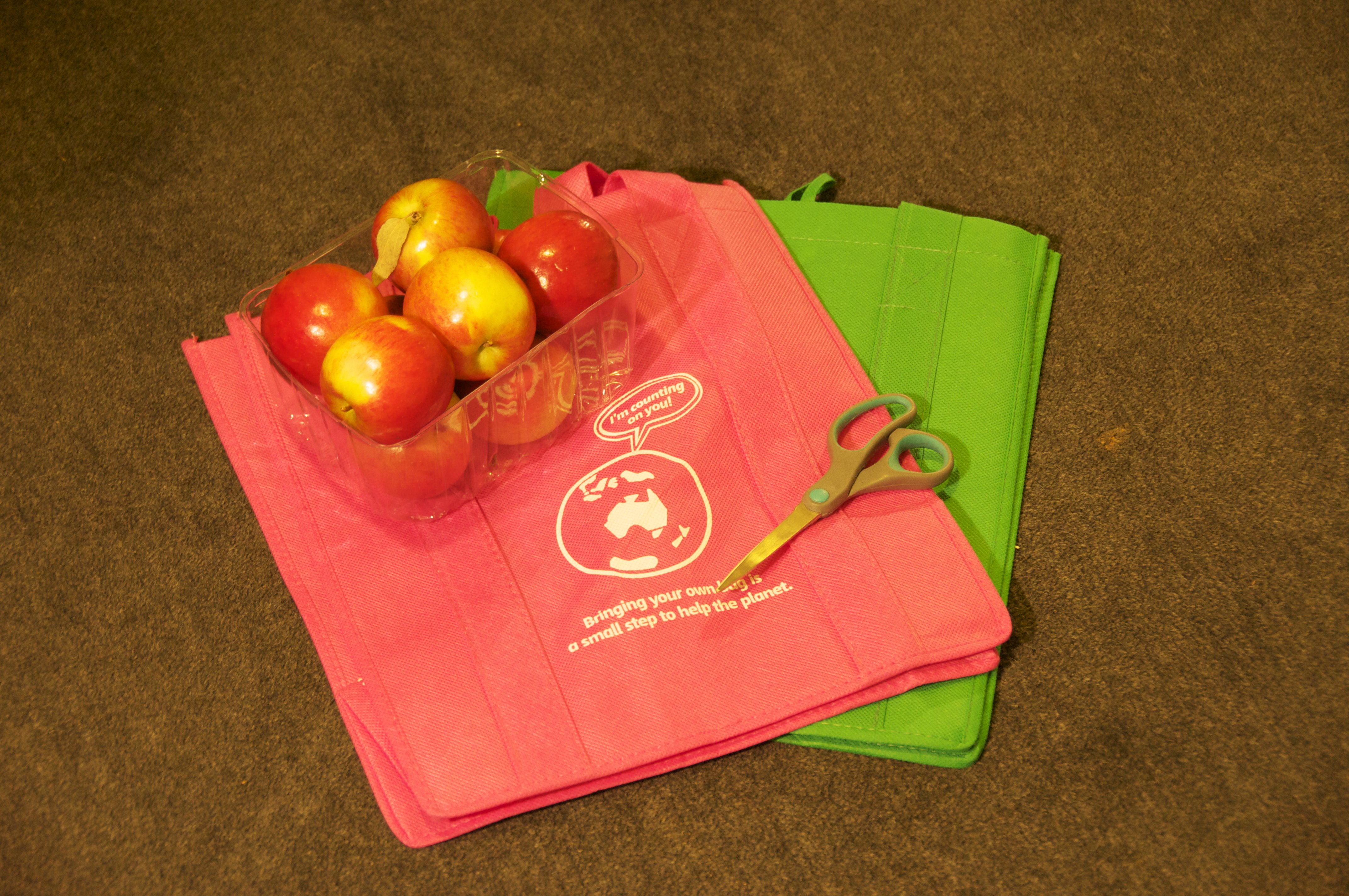
I was challenged to build something out of recycled materials that I would otherwise put in the bin. I decided to build something I’d been thinking about for a while – a vertical garden – out of plastic packaging and supermarket ‘green’ bags. I love apples and it seems bizarre to me that some apples are sold in large rectangular plastic boxes. One of the beautiful things about fruit is that it needs no packaging. I decided that these boxes would be my basic building material and over the course of two weeks ate lots of apples.

Materials

BACKGROUND

A vertical garden is a garden that is geared for the metropolitan landscape where space is at a premium. Many plants are climbers and can happily grow in the vertical plane. Walls can become living walls. This idea is starting to gain traction in architecture and expect to see more and more of them in coming years. Hanging gardens are one aspect of this vertical movement and involve sets of garden beds one underneath the other allowing excess water to flow with gravity from the higher to the lower ones.

OUTCOME

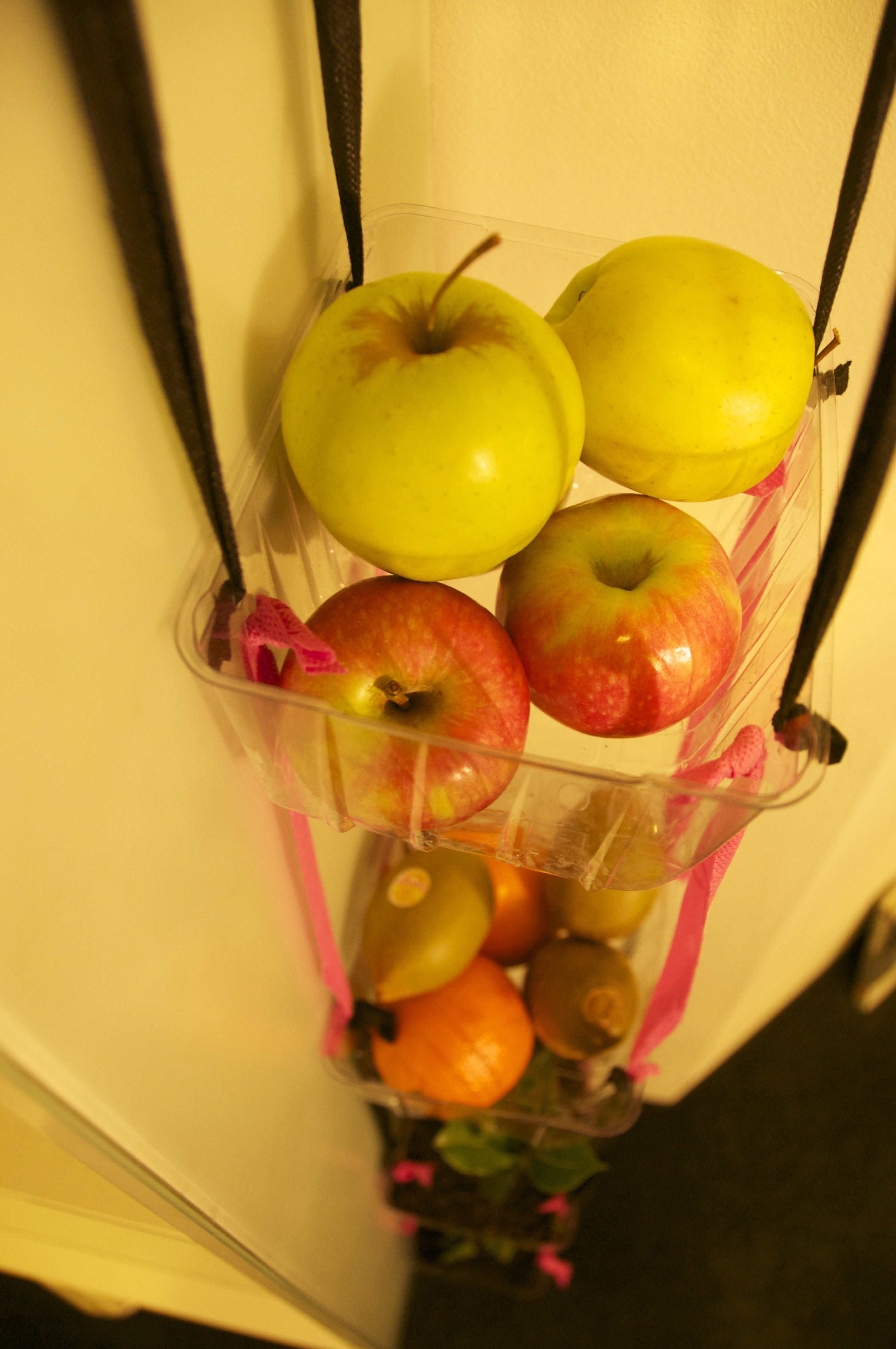
The challenge went well. You can see all the building materials in the first photo and the final result in the others. Building this vertical garden did involve tying more knots than your average Inca quipu but the plastic green bags retain the knots well with little slipping. I did some strength testing on it before adding the soil and was surprised by just how strong the whole thing was. During this phase I decided to make it a hybrid structure that was part vertical garden and part fruit basket to add some colour to the room while the greenery is growing. Lower to the ground where there is more light I planted sage leaf, a curry plant and a flower. If you love making things out of things too it would be cool to hear from you.

Top of vertical garden

Fruit holder

Plants

OTHER POSITIVE EFFECTS

Chi-cyling is definitely an uplifting experience and its the same part of you that sees the wallet in the tea box that sees the opportunity in the crisis and the silver lining in the cloud: the part that senses the possibility for transformation. So why just think outside the box when you can grab the box and turn it into something awesome!

Simon

Want to buy us a chocolate?