Author Archives: Anna

The Inklings: Chapter 37

D’arby went home to his parent’s place two days before Christmas. He had mixed feelings about the trip. Of course he wanted to see his parents and he enjoyed being closer to nature, but he didn’t like the hot dry weather. He felt anxious about bushfires – he felt the need to scan the horizon every hour or so for signs of smoke. He also felt depressed thinking that this hot dry weather was most likely just going to become hotter, dryer and more frequent as the years passed. One of the main reasons D’arby felt the need to save the world was because he wanted to stop the bush he grew up in from dying. The thought of that landscape changing was enough to fill him with sadness and if he dwelt on the thought a terrible rage would well up in him. D’arby had grown up with people who didn’t care (or wouldn’t admit to caring) about nature despite living in it. He’d had arguments with them about whether animals had any right to exist. They had made fun of him for caring about trees. He’d defended his piece of bush from them when they turned up with their spotlights and shot guns, or trailers and chainsaws. But all his efforts had been in vain – and the people who didn’t care were going to win – because climate change was going to take the bush even if D’arby was on guard 24 hours a day. When D’arby thought about climate change he had a mental picture of a red-faced young man revving his perfectly polished ute, blasting out tones of carbon dioxide and laughing because, in the battle between him and D’arby, he knew he was going to win.

To cheer himself up a bit, D’arby went for a walk just before sunset (when it was cool enough to make being outside enjoyable) and imagined what it would be like to have invented a way to remove enough carbon dioxide from the atmosphere to reverse climate change. Of course D’arby had no idea how that could be achieved and suspected that it couldn’t be (not on a scale large enough with the resources available anyway).

D’arby’s thoughts then drifted back to the red faced man in the ute. Inside the red faced man’s head D’arby imagined that there was a yearning for an endless, softly undulating, treeless landscape – like the lawn covered hills that so often get associated with “green” products. D’arby felt the red faced man’s reptilian urge to bash the crap out of anything or anyone that made him feel uncomfortable, but D’arby also knew that the man had in his brain the capability for empathy and the ability to reason.

“Why don’t people use their brains!” yelled D’arby.

To calm himself down, D’arby took some deep breaths and tried to appreciate the sunset. Then he began walking home.

“I’m trapped on a planet with people who don’t care enough about it to look after it and yet none of us have anywhere else to go” D’arby complained to himself. He couldn’t help feeling that it had all been somehow organized as a challenge.


The Inklings: Chapter 36

The next afternoon John went for a long walk. He wasn’t going anywhere in particular, he just wanted to get out of the house and do something. John was sick of being on holiday already. He wasn’t used to relaxing – he didn’t know how to enjoy it, and without anything to distract him, his mind kept wandering back to his problem of how to avoid going to gaol.

After a couple of hours of walking John needed a rest so he sat down on a seat in a park and started watching the other people in the park. Some people were sitting on the grass in the sun, others were walking their dogs, some people were conscientiously running laps and there was a group of adults watching their children play on the swings. Amongst all of this, one person caught John’s eye. There was a woman who was walking slowly around in an unpredictable pattern. “Maybe she is walking around to kill the holiday time like me” thought John. “Or maybe she’s thinking about her problems like me.” She was too far away for John to be able to work out the expression on her face so he walked closer, averting his eyes until he was near so it wouldn’t look like he was spying on her. When John got close he looked at the woman and was surprised to find that it was Syafika. He hadn’t recognized her in her hat and sunglasses.

“How are you going?” John asked. Syafika looked a bit confused when she saw him. He decided she must have been deep in thought – probably wondering about what Vincent was thinking.

“I’m ok” said Syafika

“Sorry about last night” said John.

“Don’t worry” replied Syafika. “It wasn’t your fault.”

There was a pause, which Syafika felt uncomfortable with so she added “I had to get out of the house so I wasn’t sitting around waiting for Vincent to return my calls.”

“I had to get out of the house too.” said John. “Otherwise I might have been tempted to put up some Christmas decorations. D’arby warned me to not even think about buying any, so instead I was thinking about making my own, but I know that would still be dangerous.”

Syafika was glad to have a reason to laugh and when she had finished she took the opportunity to ask John about something she’d been meaning to ask for a long time. “Hey, I think I saw you in this park months ago” said Syafika, and she couldn’t help smirking as she remembered. “You rubbed dog pooh into its owner’s hair.”

John stared blankly ahead while sifting through his memory. Eventually he came across a blurry memory of a rainy morning when he’d been feeling particularly angry.

“That sounds like something I would have done” John eventually answered and he made a mental note to add that incident to his list of things he could go to gaol for.


The Inklings: Chapter 35

It was the Sunday before Christmas. It was a hot afternoon, but not unbearably hot, just lovely Summer weather. Syafika had all the windows open to let in the warm breeze, which carried the smell of Jasmine flowers and traces of the incense that the neighbours were burning.

Fanta, D’arby and John were on their way and Syafika was clearing everything off the kitchen table to make room for them to screen print some T-shirts. All four of them were in a holiday mood, especially John because his restaurant was closed until January.

As they walked to Syafika’s place John and D’arby were each pulling a two-wheeled shopping trolleys full of blank T-shirts and screen printing materials. D’arby was hoping that this visit would be better than the last time they went to Syafika’s place. John was appreciating the contrast between how good he felt to be on holiday now with how he used to feel when he didn’t have a job to take holiday from.

Syafika had an even longer list of T-shirt ideas ready this time. She’d also made some iced tea. Her parents had gone for a walk.

John and D’arby arrived before Fanta. The combination of holiday time plus the heat and smell of flowers soon put them into a silly mood. John insisted that they put some music on and started going through Syafika’s music collection. When Fanta arrived John and D’arby were laughing as they tried to break dance to an album they remembered fondly. John put on Syafika’s bicycle helmet and was trying to spin on his head when the doorbell rang.

Syafika threw the door open without taking notice of who it was – she was busy laughing at John, who was actually pretty good at spinning on his head, and assumed it was her parents returning from their walk.

In walked Vincent. He was carrying a bunch of flowers, but did not look amused. When Syafika turned back to see who had come in the door Vincent greeted her with an expression that was a mixture of disappointment and anger. These emotions had so overcome him that all he could manage to say was “Well!” before he turned and left.

Syafika ran after Vincent, leaving John, D’arby and Fanta to look at each other guiltily. They realized now that they shouldn’t have agreed to meet at Syafika’s place, but the weather and their holiday moods had made them reckless.

Syafika wasn’t been able to get Vincent to stop walking. She chased him and tried to explain, but there really wasn’t anything to explain. Vincent had told Syafika to stay away from John and D’arby. He thought she would understand that it was a well-meant warning based on his experience. Syafika thought Vincent was being silly and bossy and had ignored his warning. She didn’t think Vincent would find out that she was still spending time with John and D’arby – Vincent had only given her a surprise visit once before, and although that was the time John and D’arby had been there Syafika hadn’t expected it to happen again.

When Syafika returned half an hour later her friends had gone. So had the screen printing stuff, and even her list of T-shirt ideas. The weather had changed. A cooler wind was blowing from another direction, bringing with it the smell of the damp manure that Rose had put on the front garden that morning.


The Inklings: Chapter 34

Binta wondered why it was that after arguing with someone she always felt so much better, even when nothing had been resolved. Ever since she’d yelled at Fanta, Binta had felt much more positive about what had happened. She and Ousman had started talking again, and most importantly, Binta wasn’t angry with him or Fanta anymore. She wasn’t quite ready to admit that she was happy about what they’d been up to, but she was excited to think that Ousman might soon meet his father. She wondered what Mamadou would think of their son and before she could stop herself, Binta started wondering what Mamadou would think of her now.

Binta remembered when, earlier that year, Fanta had given Syafika a painting done by Mamadou. Now she realized that Fanta must have known who Mamadou was when she met him on holiday and bought that painting. Indeed, Fanta must have already known who Mamadou was before she visited him – Fanta must have tracked Mamadou down and just pretended she was a tourist. Binta blushed when she realized that Fanta must have known who Mamadou was talking about when he told her (thinking she was just a tourist) that he’d been planning to marry an Australian woman until he found out that she didn’t trust him. At the time Binta wished she could have told her side of the story, but now she realized that she may as well go along with Mamadou’s version because it was true that she hadn’t trusted Mamadou. When it happened Binta thought she had good reason not to trust Mamadou, but now she could see that she had added a large amount of imagination to small inconsistencies in some of the things Mamadou said. In her head she had turned minor things into major ones and instead of asking Mamadou to explain things that didn’t make sense she’d accused him of things he hadn’t done.

“I should have known!” said Binta to herself when she remembered how every time she’d gotten angry with Mamadou he’d been able to turn things around and make it her fault. Of course it made sense that their arguments would always be at least partly because of things Binta did, so it wasn’t fair for her to assign all the blame to Mamadou in the first place, but Binta hadn’t been able to see that when she was angry. Binta hoped she was wiser now. She didn’t think that Mamadou would have forgiven her though and hoped that Mamadou wouldn’t let his anger at her affect his relationship with Ousman.


Inklings of how to save the world

Some keen readers may have noticed that The Inkling has not published a feature article since November last year (when Sustainability was posted). There is another feature in the pipeline, but because it is bigger and better than the first two it is much harder and more time consuming to prepare. To keep you entertained in the meantime, The Inkling has decided to give you some idea of what goes on when The Inkling writes these articles.

Rotating Democracy (sort of like Sortition)

By The Inkling

When looking at how to move towards a sustainable world, one thing keeps coming up – our democracy isn’t working as well as it should.

Even if we elect good people, being in a position of power changes their brains (reducing empathy), plus, of course, baddies tend to gravitate towards positions of power.

We see that vested interests keep getting their way and “the people” aren’t doing anything about it. Then most of us sit back and rely on politicians to fix things, and don’t even bother engaging with politics or the issues well enough to keep the politicians in line.

I keep hearing how the only way to solve our environmental and social problems is to get people to participate in their communities and politics, but how? And even if we managed to convince people to participate more now, how would we stop things from degenerating back to the way they are now at some time in the future (when community enthusiasm lapses)?

How many people love their politicians these days? Who would feel sad if they suddenly lost their jobs? What about political parties and powerbrokers? Who would feel much sympathy for them?

What if instead of electing politicians we took turns? Imagine if politics was like Jury Duty and it was likely that at some time during your life you’d be randomly selected to serve a Parliamentary term (or Council term)?

And what if instead of dissolving the whole Parliament at once, each person’s term expired at a different time, so that Parliament changed the representatives that made it up gradually like an animal replaces cells?

Of course there are lots of details that would have to be sorted out, like rules for how representatives could behave (they’d have to be kicked out if they broke the rules and replaced by the next random person) and the conditions under which a person could “get out of” their turn, but basically the idea would be that “the people” were responsible for governing the place. No more complaining about how crap all the politicians or parties are. And what better way to get people to be interested than to make it likely that they will have to be the one doing the job at some point!

What do you reckon? Would our politicians vote for it?


The Inklings: Chapter 33

Syafika was furious to wake up and realise that it was Monday. She’d wasted the weekend waiting for Fanta to call and apologise (which Fanta hadn’t done) and now, not only was it time to go back to work again, but because Fanta hadn’t apologized Syafika had to decide whether to demonstrate her hurt by staying home that night and missing the meeting (which she had really been looking forward to) or to go to the meeting and risk looking like she wasn’t very upset with Fanta. Syafika picked up the phone and was about to call Vincent and ask him what she should do when she realized that she couldn’t do that either because she’d promised Vincent she wouldn’t go to any more of the meetings.

Since Wednesday Syafika had been stewing. She was incredibly hurt that Fanta had been keeping secrets from her and was even more hurt (and very jealous) that Fanta had been collaborating with her awful little cousin Ousman. Another element of Syafika’s hurt was that she was starting to realize that she needed Fanta more than Fanta needed her.

At last Syafika decided to give in and go to the meeting. Staying home would just make her even angrier. Besides, Fanta would have probably made a nice cake for dessert.

Poor John wasn’t in a good way either. The scare he’d got when Vincent turned up at Syafika’s place had made him start thinking about the precarious situation he was in. Since then John had spent every spare moment thinking about how he could avoid going to gaol. He was now feeling really depressed because he couldn’t think of a way of cutting off his past. And John wasn’t worried just for himself. He could see that whatever happened to him would also affect Fanta, his family and even D’arby. It would even affect their plans to “save the world”.

Syafika was right, Fanta did make a cake for the meeting. As Fanta took it out of the oven that afternoon she was wondering whether the meeting would go any better than their first. Fanta was hoping that if she made an extra special dinner it would help Syafika forgive her. Fanta was also worried about John, who had been distant that week. She could tell something was on his mind but when she asked him if anything was wrong he tried to pretend that nothing was.

D’arby was oblivious to all the dramas of his friends. He had been too engrossed in his latest draft of his plan to save the world to notice that John was depressed.

Fanta finished setting the table just at the time they’d agreed to meet. Then she looked out the window but couldn’t see any of her guests coming so she went to check that there was a fresh hand towel in the bathroom. Fanta then spent the next half an hour doing various unimportant household jobs, and checking out the window every five minutes or so. Finally she sat down and regretted having organized for her aunt and uncle to take her sisters out for the evening because it looked like nobody was going to turn up for the meeting. Who was going to eat all the food now?

Then there was a knock at the door and the next thing Fanta knew, John and D’arby were showering her with excuses for being so late. Just behind them was Syafika. She came in without saying much and soon all of them were sitting around the table.

Dinner was strangely silent. D’arby kept getting out his notes, looking at them, folding them up and putting them back in his pocket. The rustling sound was annoying Syafika. She hadn’t brought any notes this time. She’d been too angry to remember to bring her notes and was disappointed because she couldn’t remember her ideas without them.

Everyone was relieved when the dinner had all been eaten, even Syafika. As Fanta poured everyone cups of tea, D’arby skimmed through his notes once more and then stood up, cleared his throat and began.

“I’ve been trying to work out whether there is any root cause to the rot we were talking about last week. Is there any one thing that we can focus on that will make more difference than others? Anyway, this is what I’ve come up with so far:

It all started while I was watching the news. The usual finance reporter was showing graphs and talking about how consumers where still saving rather than spending so the retail outlook was grim and economic growth was threatened. I started to wonder whether all these “consumers” were really saving, or whether they’d made the same realization that I’d made and had decided they didn’t want to be consumers anymore. What if everyone stopped buying so much because they didn’t want to keep using resources unsustainably? What would that do to the economy? Would there be a recession? A depression? What are those things anyway? Can our economic system survive if we live more sustainably? I mean, even with increased efficiency, continual economic growth is impossible so either we stuff the planet or we stuff the economy, right? I know I’m not the only person who can see this problem so why are we so determined to stick to this path? Why aren’t we changing the economy?

I’d be surprised if it wasn’t those who benefit from the current system who are keeping things on the current path – so we may as well blame the richest people, but it isn’t just their fault because everyone else is letting them get away with it.

Anyway, if these rich people don’t care that they are destroying the planet and that they will be remembered as having been the biggest arseholes who ever lived, then why not? Are they psychopaths? Let’s assume that they are, even just for the fun of it.”

D’arby paused and looked at his audience. They seemed to be paying attention but he wasn’t sure they were following. He hadn’t been following his notes so he put them down on the table and just kept talking without them.

“I guess you’ve heard how corporations are inherently evil, and probably run by psychopaths and that corporations influence our governments so we can probably blame them for keeping us on a path to destruction – psychopaths via corporations, that is. And corporations probably turn normal people into virtual psychopaths too.

So what can we do about it? Can we make the normal people fight the system? Or can we fight the psychopaths directly? Or both?

I’ve been reading papers about psychopaths and I can’t say things are very clear. There isn’t total agreement on what one is, let alone on what to do about them. Some people reckon they might be able to come up with a treatment, but I can’t imagine psychos volunteering to take medication. I also worry that if we knew what makes a psycho someone would probably have a go at creating more of them – in some professions having empathy holds you back.

This gets me back to behaviour and the only thing I’ve ever been able to change. I think I know how to cure addiction, but can I cure a psychopath? Should I spend my time trying to work out how to do something I’m not sure I’ll ever be able to do or should I spend my time doing something I have already done before? Or can we do both?”

D’arby stopped again and looked at his audience, waiting for an answer but their faces were blank. This response made D’arby very annoyed. He sighed and sat down, shaking his head and was about to voice his disgust when John’s face lit up.

“I think he means he agrees with my idea and that we should keep putting the pills in the pizzas!” said John, with a triumphant smile on his face.

D’arby let out an exasperated laugh and then said “Yes, but only while we try to work out what else we can do.”

Fanta and Syafika just nodded and wondered what their roles in this plan were going to be.


The Inklings: Chapter 32

D’arby came home from the garlic harvest in high spirits, and that was despite leaving before the workshop home brew fridge was opened. He’d thoroughly enjoyed the day. D’arby had forgotten how delightful physical work could be. Once he got over the sweatiness and dirtiness of digging up the garlic his mind had relaxed and wandered off all over the place. D’arby had had so many good ideas that afternoon that he’d rushed back to write them down before joining the celebrations.

As D’arby walked in he noticed that Jinabu and Andrew had packed up their things. They had been waiting for D’arby to come home so they could tell him their good news.

“We’ve decided to go home tomorrow morning” Andrew announced. D’arby looked at Jinabu for confirmation. He was disappointed. While D’arby hadn’t really expected that Jinabu would leave Andrew permanently, he had hoped that they (and he) would be staying a bit longer.

Jinabu laughed when she saw D’arby’s expression. “Don’t blame me that we are leaving!” she said. “You shouldn’t have made Andrew such a good coffee this morning. He’s been in such a lovely mood since then that I could hardly refuse anything he asked.”

D’arby decided to avoid saying anything about the coffee. Instead he wondered out loud whether Ark would mind if he stayed for a few days by himself, but then he succumbed to the temptation of travelling home with Jinabu and decided to go home the next day too. That way D’arby could avoid another strange train journey on his own and would get home in time to spend the weekend refining his new ideas – in time for the Monday meeting.

The next morning D’arby, Jinabu and Andrew had breakfast with Ark before leaving. Ark was in a good mood. He promised to come and visit them soon.

They stopped in town to buy some food for the trip. When they got out of the car they could hear someone strumming on a guitar while preaching. D’arby was only half surprised to see that it was the crazy man from the train. Guitar-man was standing on a milk crate. He stared straight ahead as he recited his sermon, but D’arby couldn’t make out what he was saying until he walked closer. When D’arby heard the familiar words he stopped walking and looked at Jinabu. “How embarrassing” thought D’arby. Jinabu stopped too and listened to what Guitar-man was saying for a while before laughing and saying to D’arby “He sounds just like you.” D’arby gave a sarcastic laugh but didn’t tell Jinabu that Guitar-man was reciting his plans for saving the world.


The next feature article

Some keen readers may have noticed that The Inkling has not published a feature article since November last year (when Sustainability was posted). There is another feature in the pipeline, but because it is bigger and better than the first two it is much harder and more time consuming to prepare. To keep you entertained in the meantime, The Inkling has decided to give you some idea of what goes on when The Inkling writes these articles.

The Political Compass

By The Inkling

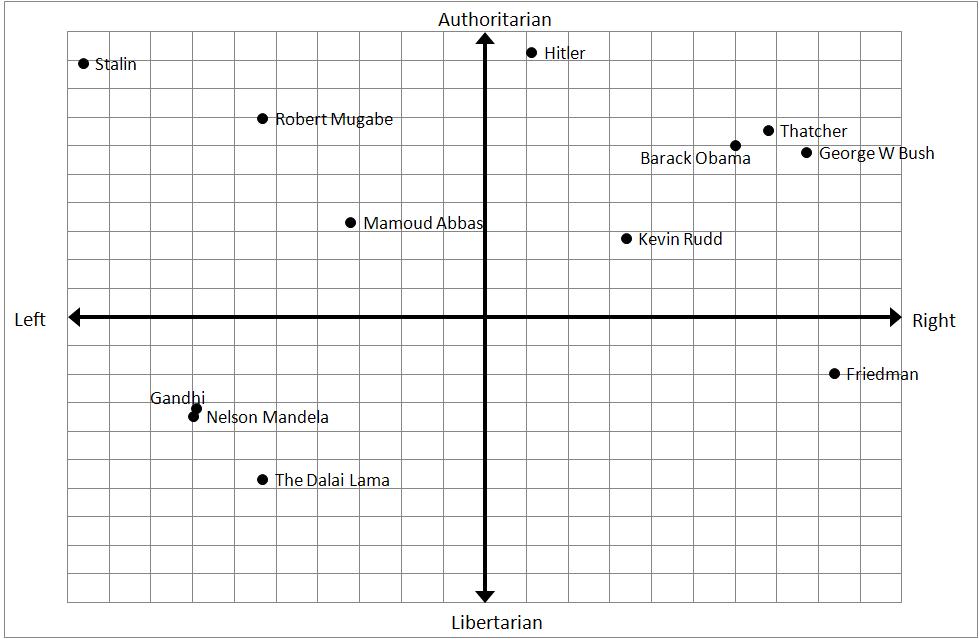
Political views get lots of funny labels. You can be left-wing, right-wing, liberal, conservative, neo-liberal, a fascist, a communist or an anarchist. I wasn’t about to be tricked into thinking that the Liberal party is necessarily for liberals but I wasn’t exactly sure what all these labels meant. While I was looking for answers I found a very useful site called Political Compass that has a clever way of classifying your political position. Rather than using a linear right-left scale it plots political views in two dimensions: economic and social.

The x-axis is the economic dimension, ranging from Communism on the left (an entirely state-planned economy) to Neo-liberalism on the right (a completely deregulated economy).

The y-axis is the social dimension, with Authoritarian (Fascism) at the top and Libertarian (Anarchism) at the bottom.

There is a test you can take, which plots your political position on the compass.

The site also includes analysis of political parties and leaders so you can see how your views compare with theirs. I’ve combined the positions of some political leaders given in two separate charts on the analysis page of the Political Compass site into Figure 1. I’m happy to report that my dot on the compass was closer to that of Gandhi than Hitler or Stalin or Thatcher.

Figure 1. Leaders on the political compass (based on http://www.politicalcompass.org/analysis2)

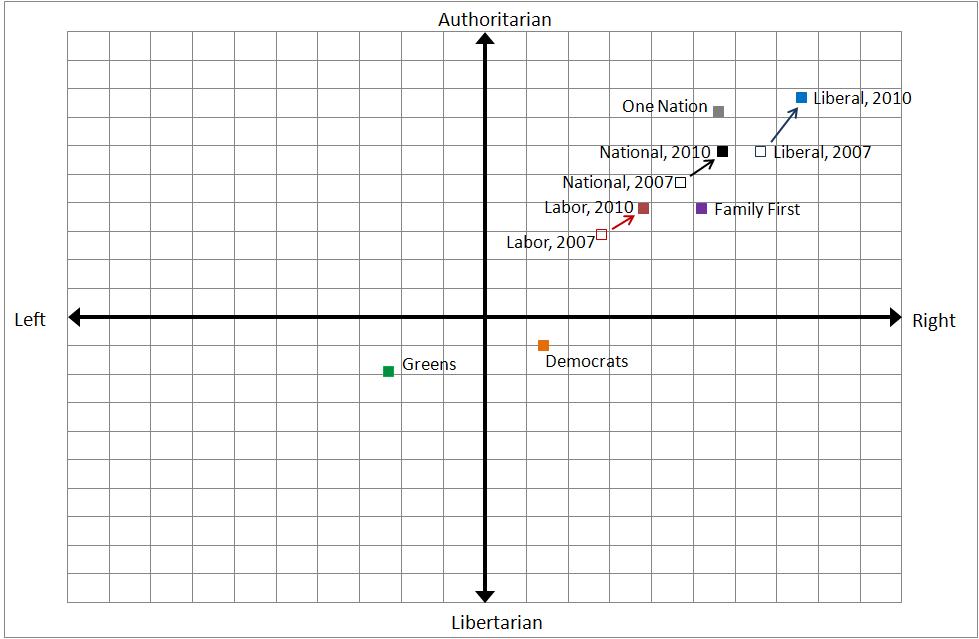
The Australian federal parties at each of the two last elections (2007 and 2010) have also been plotted on the Political Compass site. Only the four major parties (Labor, Liberal, National and Green) were shown for 2010. The chart for 2007 includes Family First, Democrats and One Nation too. In Figure 2 I have combined the charts for 2007 and 2010.

From Figure 2 it can be seen that most of the parties are located in the right-wing authoritarian (top right-hand) quadrant. These parties accounted for 84% of the vote at the 2010 Federal election. There is only one party in each of left and right-wing libertarian quadrants and there are no parties in the left-wing authoritarian (top left-hand) quadrant. I suppose this should reflect the Australian population but I wonder if it does- if the political positions of all Australians were plotted on the compass would they fall most densely where the parties that received the most votes are plotted?

The other thing I noticed was that between 2007 and 2010 the Labor, Liberal and National parties became more right-wing and authoritarian (they moved closer to the top right hand corner). The Greens were plotted in the same position in both years.

Figure 2. Australian Political Parties in 2007 and 2010 (based on http://www.politicalcompass.org/aus2007 and http://www.politicalcompass.org/aus2010)

It is interesting to think about how the movement of the Labor and Coalition parties further towards right-wing authoritarian affected their votes. In 2007 Labor won the election easily but in 2010 it only managed to form a minority government. The Liberal-National coalition vote increased but not as much as the Green vote.

You may be wondering where the Communists would be plotted. I was left wondering that too. Perhaps if they received more votes (The Communist Alliance party received 0.01% of primary votes in the House of Representatives in 2010) they’d get their point plotted too.


The Inklings: Chapter 31

Fanta was anxious as she walked to Syafika’s place. Syafika had invited Fanta to dinner because Ousman and Binta were also coming for dinner and Syafika hoped that Fanta being there too would somehow make it more bearable. Fanta had a feeling that there would be arguments tonight though.

When Fanta arrived she found Rose in the front garden. Rose was busy digging up her gardenia bushes.

“What are you doing?” asked Fanta, with pain in her voice. The gardenias were flowering and smelt beautiful. Fanta couldn’t understand why Rose would be destroying them.

Rose stood up and pointed down the street. “Look!” she said. “See how many houses now have vegetables growing in their front yards? I used to grow vegetables and herbs and tomatoes in the front yard, but then all the rich people started moving into the street and they looked down their noses at me and complained that the fertilizer I was using stank, so I moved the veggie patch to the back yard and planted gardenias here instead.”

Rose paused so that Fanta had time to peer down the street. Then she continued.

“Well, then a few months ago it started to be trendy to grow your own vegetables and so now everyone has been pulling up their gardenias and planting vegetables! See number 32? They even have a worm farm!” said Rose.

“That black box on legs?” asked Fanta

“Yes! So now I’m going to plant basil and chives and chillies and rockmelons and sunflowers and zucchinis and whatever else I like! And then I’m going to put on the stinkiest fertilizer I can find. I might even try to get some chicken or cow pooh” said Rose and she chuckled.

As Fanta looked up the street she noticed that Rose had by far the biggest front yard. Fanta the real estate agent chuckled as she estimated the value of the land that would soon be covered in manure.

Fanta was going to ask Rose where Syafika was and whether Ousman and Binta were there yet, but Rose had returned her attention to digging, so Fanta went inside instead. Not surprisingly, Binta was in the kitchen preparing dinner. Ousman was there too. Binta had given him the job of washing the vegetables and while he wasn’t reluctant to do the job, he wasn’t giving it his full attention. When he heard Fanta say hello to his mother, Ousman turned around with a smile on his face. Binta wasn’t smiling though. She stopped what she was doing and looked sternly at Fanta.

“Where do I start!” said Binta. “How dare you interfere in my life in such a way! How dare you!”

Fanta realized that Binta had found out about her secret project. She hadn’t really expected such anger to be directed at her though. Fanta was certain she’d been doing a good thing.

When Fanta didn’t respond Binta continued “Why didn’t you talk to me about this? Didn’t you think I had the right to know what my own son was up to?”

“Ousman begged me to help him and not to tell anyone” explained Fanta, but she could see that perhaps she hadn’t done the wisest thing and that she should have consulted Binta.

“What are you doing here anyway? How can you think you know what is right for my son when you are always leaving your daughters at home and going out on your own?” said Binta angrily and then she turned her back on Fanta and pretended to be stirring the contents of a saucepan.

There were plenty of things Fanta could have said, but because she could feel tears forming in her eyes she turned and left instead. As she walked off down the street Fanta knew that she would regret not having stayed to explain things, but couldn’t bear to go back. Fanta was used to people she didn’t know assuming that her sisters were really her daughters, but she hadn’t expected it from someone she considered to be a friend. She imagined Syafika’s family discussing her – talking about her having been a teenage mother and how she tried to trick people into thinking her kids were her sisters. Fanta wondered what Syafika really believed. Fanta’s sisters were almost young enough to be her children and she was their guardian but Fanta was hurt that these people might not believe her when she said they were not her children.

Fanta was also hurt by Binta saying that she didn’t know what was good for Ousman. Maybe Syafika hadn’t told Binta how Fanta’s father had died just before Fanta’s youngest sister was born, or how Fanta’s mother had then abandoned them all and run off with a new man. After going through that, Fanta thought she did have some idea of what Ousman felt when his mother didn’t want him to know who his father was.

Fanta wondered whether Binta was right to think that Fanta shouldn’t go out and leave her sisters behind. Fanta had always considered that she should be able to have a separate social life, like she would have if her parents had been around. She never left her sisters on their own, they always had a babysitter, and tonight they were home with their aunt and uncle, who were practically their parents anyway.

Fanta wondered what would have happened if she had proposed to Binta that they try to find Ousman’s father. She knew Binta’s initial answer would have been “No!”, but would Binta have eventually changed her mind? Fanta decided that Binta probably would have eventually agreed with the plan to find Ousman’s father and Fanta began to regret not having discussed it with Binta first. She wished she had been able to say so.

After gathering her thoughts on the walk home, Fanta realized she needed to call Syafika, who would at least need to know why she hadn’t stayed for dinner. Festus answered the phone. He’d been instructed to tell Fanta that Syafika was too angry to talk to her. “Of course Syafika feels betrayed too” thought Fanta. She could imagine how angry Syafika would feel when she found out that she’d been left out of a secret.

After Fanta explained to her aunt and uncle why she’d come home so early her uncle told her his news. He’d had a phone call. The letter had been delivered successfully. Fanta smiled and hoped she’d eventually be forgiven.


When Sparks are Ignored: Egotism

One of the greatest pleasures for a Spark is to reside in the brain of a human who has what people like to call a “small ego” – someone who thinks of themselves more as a part of something larger than as an individual. When a person with a small ego has an idea they are likely to attribute it to something outside of themselves (something they plucked out of the air as it was floating past). People like that are usually very receptive to the ideas of Sparks, and they often go on to become very successful people.

The trouble is that the size of a person’s ego can change, and in most cases when a person is successful their ego grows and before they know it their ego has well and truly taken over. They no longer think of themselves as part of something bigger, but think only of themselves. An egotist thinks that any ideas they have had were entirely their own creation – they not only start ignoring their Spark, they start denying it even exists. So, you can see why they might find that their Spark decides to leave them.

This is a common story – lived out by artists, business people and revolutionary leaders-turned dictators. At the start they recognize their small part in the world and long to do their best or something “good”. A Spark tunes into their longing and joins them and the ideas and energy start flowing. Then the person starts doing something well. If this is recognized it leads to success and then praise, which are both good fertilizer for growing egos. Then, just when the person has grown an enormous ego and the world is watching and waiting for them to perform, they lose their Spark.

You can imagine the feelings of helplessness that develop in this situation. Rage often follows. Then comes the decline, which usually includes humiliating attempts to cling to fame and/or power. Lies and murder are possible. The egotist watches their friends and supporters fleeing. You can imagine the loneliness and feeling of betrayal. Finally they are alone, and not part of anything anymore. As a final blow to the ego, the person may find that history remembers them for their desperate acts in the dying days of their power rather than for their initial good deeds and intentions.

The pattern of success driven ego growth followed by decline can happen on other scales too. It is a common cause of project failure because when egos take over people place more importance on getting things done in “their” way than on the success of a project and spend time arguing over unimportant details instead of cooperating. A similar thing happens between people who are fighting for the same cause but all want the victory to be “theirs”.

Good ideas don’t have to lead to egotism though. There are some people who are able to keep their ego small even when they have great success.  When these people have good ideas they realise that their inspiration came from outside of themselves. They attribute their idea to things such as the colour of the sky that morning, the song they heard on the radio and a conversation they overheard on the bus. Small ego people know that they cannot exist alone. They remember that they wouldn’t have been able to even feed and clothe themselves without the things other people have done. Even a billionaire needs to realize that they could not have generated that money on their own. Not only do they rely on a workforce that could probably find something much better to do if they weren’t slaves to their mortgage or “lifestyle”, but that the workforce relies on the rest of society. And just as everyone relies on other people for their survival, our ideas are also products of the same system. Acknowledging this is a strategy that cannot lose. Not only are you more likely to keep your Spark, but if you remember that you aren’t doing everything on your own then when things go wrong you aren’t on your own either.